Musing on the Hugo, Nebula, World Fantasy, and Locus Awards

With the announcement of the finalists for the Locus Awards earlier this month, I thought I’d take some time to muse on why we pick out certain stories for recognition and to also relate some information on the awards that I follow (Hugo, Nebula, World Fantasy, Locus).

I recently read some of the nominees for the Nebula Awards so that I could vote for these (my pick for short story was The Sound of Children Screaming, which can be found here). I’ve also been reading some of the short stories that won Hugos and/or Nebulas in the past couple of years (Rabbit Test, If You Find Yourself Speaking to God, Address God with the Informal You).

So what’s with all these awards? What does each one mean? Who votes for them? And why does anyone care?

First of all, I think that it is important to provide recognition for outstanding talent and achievements in any field. The nomination and awards process also highlights a set of work and helps readers find stories that they might not have been otherwise aware of. Let’s go through each of these major awards and talk about the nomination process, categories, and other information about each one.

Hugo Awards.org media download site, Fair use, https://en.wikipedia.org/w/index.php?curid=60413579

Hugo Awards

The Hugo Awards have been awarded since 1953 and are named for Hugo Gernsback, the founder of the first classic magazine of science fiction, Amazing Stories. The current categories awarded include Best Novel (>40,000 words), Best Novella (17,500 to 40,000 words), Best Novelette (7,500 to 17,500 words), Best Short Story (<7500 words), Best Series, Best Related Work, Best Graphic Story, Best Dramatic Presentation (long and short forms), Best Semiprozine, Best Fanzine, Best Professional Editor, Best Professional Artist, Best Fan Artist, Best Fan Writer, Best Fancast, and Best Game or Interactive Work.

The Hugos are one of the most prestigious awards for the science fiction and fantasy genre. A list of nominees and winners can be found here. The Hugo Awards are presided over by the World Science Fiction Society. Attending and supporting members of the World Science Fiction Convention can nominate and vote on the awards. Even if you can’t attend the convention physically, you can purchase a supporting membership for voting privileges. The physical awards are announced and presented at that year’s World Science Fiction Convention (Worldcon), which is held generally around September and moves to a different city each year (2024 = Glasgow).

The Hugo Awards have been associated with some recent controversies. The Sad Puppies ran a campaign to nominate slates of works in reaction to the recent success of BIPOC authors and overall diversification in the genre. This led to several nominated authors declining to have their works considered (when included on the Sad Puppy slate), and No Award being selected in several categories where the Sad Puppy nominees dominated. The World Science Fiction Society made changes to the nomination and voting process in 2017.

More recently, the 2023 Hugo Awards became the source of another controversy when the voting statistics from the recent Worldcon held in Chengdu, China were released (scroll down to page 20 on the linked .pdf). Authors whose work may have been considered too political for Chinese censorship laws had received nominating votes, but were declared ineligible. Other votes from Chinese citizens were thrown out because they were considered to be following a slate suggested by a magazine (despite the rules not permitting this). Going forward, the Hugo administration has vowed to improve transparency in the process. You can find more details about what happened here.

The logo is from the following website: http://www.sfwa.org/ Nebula Awards official website, Fair use, https://en.wikipedia.org/w/index.php?curid=35826707

Nebula Awards

The Nebula Awards follow a similar process, with the main difference being that those who nominate and vote for these awards must be members of the Science Fiction and Fantasy Writers Association (SFWA). This is the professional organization for authors, artists, and editors in the science fiction and fantasy genres.

Categories for the Nebula Awards currently include Best Novel, Best Novella, Best Novelette, Best Short Story, and Best Game Writing (same word count requirements as for the Hugos). Other awards that are not technically Nebula Awards are also included in the Nebula process. These recently have included the Andre Norton Award for Outstanding Young Adult Science Fiction of Fantasy Book, the Ray Bradbury Award for Outstanding Dramatic Presentation, the Damon Knight Memorial Grand Master Award (for lifetime achievement), Author Emeritus (awarded posthumously for lifetime achievement), the Kevin O’Donnell Award for service to SFWA, and the Kate Wilhelm Solstice Award for significant impact on speculative fiction.

The Nebula Awards go through a similar round of nominations followed by voting, with the announcement and presentation of the winners at the SFWA Nebula Conference. This is usually in the spring and is held in the United States (2024 = Pasadena, California).

World Fantasy Awards

The World Fantasy Awards are a favorite of mine, I think because I lean more toward fantasy in my reading overall. These are administered by the World Fantasy Convention, which occurs annually in a different location around the world (2024 = Niagara Falls, New York). While the World Science Fiction Convention is a larger event with plenty for fans of the genre, the World Fantasy Convention is a professional event for authors, artists, editors, agents, and publishers. It can be a great place to meet people in the field for an upcoming author.

The World Fantasy Award nominees are partly selected by the attendees of the World Fantasy Convention, but also by a panel of judges who are professionals in the field. The categories for awards are Best Novel (>40,000 words), Best Novella (10,000 to 40,000 words), Best Short Fiction (<10,000 words), Best Collection (single author), Best Anthology (multiple authors), Best Artist, Special Award–Professional, Special Award–Non-Professional, Convention Award, and Life Achievement Award.

Controversy about the physical award arose in recent years. It had formerly been a bust of H.P. Lovecraft who has been criticized for his outspoken racism. The new award was changed to the one pictured in 2016.

Locus Awards

Designed by Francesca Myman, with art by Shaun Tan and presented by Locus Magazine. Source: Locus. – Original publication: Locus Magazine Immediate source: https://locusmag.com/2020/06/locus-awards-winners-2020/, Fair use, https://en.wikipedia.org/w/index.php?curid=68857244

The Locus Awards are put together by Locus Magazine, which is a monthly trade publication for the science fiction and fantasy genre. The awards are open for nomination by the public and the votes of subscribers to the magazine count twice. You can find the recent top 10 nominees here.

Categories for the Locus Awards include Best Science Fiction Novel, Best Fantasy Novel, Best Horror Novel, Best Young Adult Novel, Best First Novel, Best Novella, Best Novelette, Best Short Story, Best Anthology, Best Collection, Best Magazine, Best Publisher, Best Editor, Best Artist, Best Non-Fiction, and Best Illustrated and Art Book.

The winners are announced during an awards presentation that is associated with a weekend of readings and panels held in Oakland, California this year.

This has turned out to be a longer post than I thought it would be, but I hope it was helpful to explain some of the honors awarded in the science fiction and fantasy genres.

Have you voted for any of the awards? Which books have you read that won one of these awards? Let me know in the comments (above).

Book Review – Never Say You Can’t Survive

This was a book that I had picked up at New York Comic-Con in… probably 2021. The full title of this how-to book on writing by Charlie Jane Anders is Never Say You Can’t Survive: How to Get Through Hard Times by Making Up Stories. It has been some time since I’ve read this type of book, so I thought that this would be a good time to delve back in to learning how to improve my writing process.

This book also won the 2022 Hugo Award for Best Related Work.

Paid links help to support this blog.

Here is the blurb:

Things are scary right now. We’re all being swept along by a tidal wave of history, and it’s easy to feel helpless. But we’re not helpless: we have minds, and imaginations, and the ability to visualize other worlds and valiant struggles. And writing can be an act of resistance that reminds us that other futures and other ways of living are possible.

Full of memoir, personal anecdote, and insight about how to flourish during the present emergency, Never Say You Can’t Survive is the perfect manual for creativity in unprecedented times.


I did enjoy this book and I felt like I learned some useful tips. It has found a space on the back portion of my desk where I keep books about writing for easy reference. I have also read two of this author’s novels, so I was able to understand the given examples when she references those stories. One of them (All the Birds in the Sky), was one of my favorite books I read in 2019, review here.

Never Say You Can’t Survive is divided into 5 sections, roughly on these topics:

  1. Getting Started – this deals with creating characters.
  2. What’s a Story and How Do You Find One? – this is about how to take a premise and turn it into a story.
  3. Your Feelings Are Valid – And Powerful – this is about using emotions to write effectively.
  4. What We Write About When We Write About Spaceships – this section tackles using your political and social outlook to say something in your writing.
  5. How to Use Writerly Tricks to Gain Unstoppable Powers – this contains some specific tips on the mechanics of writing: point-of-view, structure, tone, etc.

If you are just getting started as a writer, this book isn’t the place to start, as it doesn’t deal with the basics. But if you have some writing experience already and want to look at some finer points in how to craft stories, I think this volume may be helpful.

Have you read this book? Do you think it will be helpful to your writing? Let me know in the comments (above).
Find more of my reviews here.

Book Review – The Graveyard Book

I have been gradually working my way through some of Neil Gaiman’s books, having previously read some of The Sandman, American Gods, and Neverwhere (review here). Next up on my list was The Graveyard Book.

This book is classified as a middle grade novel, but it never felt like something purely intended for children. The Graveyard Book won the Newberry Medal, the Carnegie Medal, the Hugo Award for Best Novel, and the Locus Award for Best Young Adult Book.

Paid links help to support this blog.

Here is the blurb:

Nobody Owens, known to his friends as Bod, is a perfectly normal boy. Well, he would be perfectly normal if he didn’t live in a graveyard, being raised and educated by ghosts, with a solitary guardian who belongs to neither the world of the living nor the world of the dead.

There are dangers and adventures for Bod in the graveyard: the strange and terrible menace of the Sleer; a gravestone entrance to a desert that leads to the city of ghouls; friendship with a witch, and so much more.

But it is in the land of the living that real danger lurks, for it is there that the man Jack lives and he has already killed Bod’s family.

A deliciously dark masterwork by bestselling author Neil Gaiman, with illustrations by award-winning Dave McKean.


I enjoyed this book and found it to be a quick read. The illustrations by Dave McKean added to the imagery and mood of the story. Apparently this novel was inspired by The Jungle Book, and many of the scenes parallel the events of Kipling’s work.

The story starts out with a frightening scene in the aftermath of the murder of Bod’s entire family. This sounds like a dark opening for a middle grade book, but it is never graphic. Once Bod is adopted by the ghosts of the local graveyard and his vampire guardian, Silas, the menace fades from his day-to-day life until later in the book.

Bod still encounters dangers, but also friends. Each section of the book jumps ahead a couple of years in time, so we see Bod grow up and explore further afield, finding trouble in a variety of places. Finally, the story moves back to the murder of his family and brings it all together for the conclusion. I thought that the ending of this book was bittersweet, but since this is also a coming of age tale, it was also appropriate to that theme.

Have you read The Graveyard Book or other novels by Neil Gaiman? Let me know in the comments above.

Find more of my book reviews here.

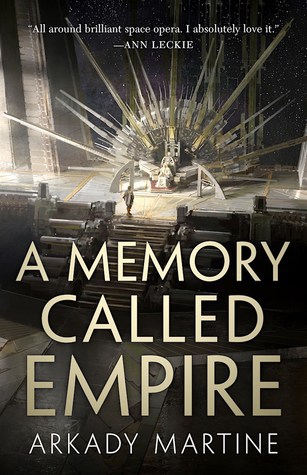
Book Review – A Memory Called Empire

I had been meaning to get to this book for some time since it won the 2020 Hugo Award for Best Novel. For some reason I had it in my head that this was a fantasy novel, but A Memory Called Empire by Arkady Martine is actually a science fiction tale of politics and intrigue.

Paid links help to support this blog.

Here is the blurb:

Ambassador Mahit Dzmare arrives in the center of the multi-system Teixcalaanli Empire only to discover that her predecessor, the previous ambassador from their small but fiercely independent mining Station, has died. But no one will admit that his death wasn’t an accident—or that Mahit might be next to die, during a time of political instability in the highest echelons of the imperial court.

Now, Mahit must discover who is behind the murder, rescue herself, and save her Station from Teixcalaan’s unceasing expansion—all while navigating an alien culture that is all too seductive, engaging in intrigues of her own, and hiding a deadly technological secret—one that might spell the end of her Station and her way of life—or rescue it from annihilation.

This book was a wonderful and fast read for me. I had some trouble keeping the people straight at first, as the citizens of the Empire were named after first a number and then an inanimate object (ex. Three Seagrass).

The protagonist, Mahit, has studied the language and the culture of the Teixcalaanli Empire for her whole life and carries the memories and some of the personality of the previous ambassador in an implant next to her brain. When this implant malfunctions, she is at the mercy of her local liason and newly formed political connections that might be trying to kill her, making her a sympathetic outsider and a fun character to read about.

The world-building was intricate, and even though we only see a small portion of the Empire, it all felt very real. The characters were plausible and well-drawn, and the ending was a shock that made sense in hindsight.

While a second book was just released, the story in A Memory Called Empire does reach a satisfying conclusion, so you could read this as a stand-alone if you wish. I’m planning to read the next book, A Desolation Called Peace very soon though!

Have you read this book? Let me know in the comments above.

Find more of my book reviews here.

Book Review – The City & The City

I had wanted to read something by China Miéville for some time and this novel came up in one of my book clubs. So I finally had my chance. The City & The City is a stand-alone novel that tied for a Hugo Award for best novel, won the Locus Award, World Fantasy Award, and Arthur C. Clarke Award, and was nominated for a Nebula Award.

Paid links help to support this blog.

Here is the blurb:

When a murdered woman is found in the city of Beszel, somewhere at the edge of Europe, it looks to be a routine case for Inspector Tyador Borlú of the Extreme Crime Squad. But as he investigates, the evidence points to conspiracies far stranger and more deadly than anything he could have imagined.

Borlú must travel from the decaying Beszel to the only metropolis on Earth as strange as his own. This is a border crossing like no other, a journey as psychic as it is physical, a shift in perception, a seeing of the unseen. His destination is Beszel’s equal, rival, and intimate neighbor, the rich and vibrant city of Ul Qoma. With Ul Qoman detective Qussim Dhatt, and struggling with his own transition, Borlú is enmeshed in a sordid underworld of rabid nationalists intent on destroying their neighboring city, and unificationists who dream of dissolving the two into one. As the detectives uncover the dead woman’s secrets, they begin to suspect a truth that could cost them and those they care about more than their lives.

What stands against them are murderous powers in Beszel and in Ul Qoma: and, most terrifying of all, that which lies between these two cities.

Casting shades of Kafka and Philip K. Dick, Raymond Chandler and 1984, The City & the City is a murder mystery taken to dazzling metaphysical and artistic heights.

Overall, this book just wasn’t for me. I found the author’s writing style hard to follow and I can’t pinpoint exactly why. Something about the sentence structure and the way he writes dialogue made this a hard book to get into.

The story started off intriguing enough with a murder investigation in a strange mish-mash of coexisting cities, their separation enforced by the mysterious power of Breach. I felt like the plot dragged and it wasn’t until about two-thirds of the way through the story that it became more suspenseful.

This next part is a little spoilery:

What bothered me the most about this book is that the most fascinating aspect – the nature of the two cities and rumor of a secret third city – was not the point of the book. The murder is solved and has a mundane explanation, while the third city is just a red herring. Meh.

Have you read anything by China Miéville? Would you recommend a different book of his based on my problems with this one? Let me know in the comments.

Find more of my reviews here.

Book Review – All Clear

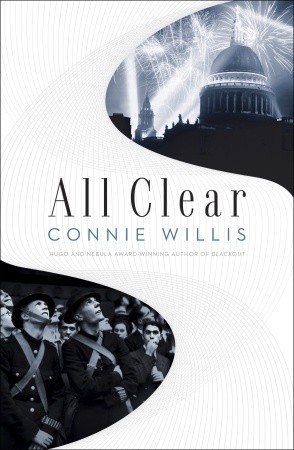
I just finished listening to the audiobook version of All Clear by Connie Willis, narrated by Katherine Kellgren. This book is the second part of one long story that started in Blackout, which I reviewed here, and is part of the author’s larger Oxford Time Travel book series. This duology won the Hugo, Locus, and Nebula awards.

Paid links help support this blog.

Here is the blurb:

In Blackout, award-winning author Connie Willis returned to the time-traveling future of 2060—the setting for several of her most celebrated works—and sent three Oxford historians to World War II England: Michael Davies, intent on observing heroism during the Miracle of Dunkirk; Merope Ward, studying children evacuated from London; and Polly Churchill, posing as a shopgirl in the middle of the Blitz. But when the three become unexpectedly trapped in 1940, they struggle not only to find their way home but to survive as Hitler’s bombers attempt to pummel London into submission.

Now the situation has grown even more dire. Small discrepancies in the historical record seem to indicate that one or all of them have somehow affected the past, changing the outcome of the war. The belief that the past can be observed but never altered has always been a core belief of time-travel theory—but suddenly it seems that the theory is horribly, tragically wrong.

Meanwhile, in 2060 Oxford, the historians’ supervisor, Mr. Dunworthy, and seventeen-year-old Colin Templer, who nurses a powerful crush on Polly, are engaged in a frantic and seemingly impossible struggle of their own—to find three missing needles in the haystack of history.

Told with compassion, humor, and an artistry both uplifting and devastating, All Clear is more than just the triumphant culmination of the adventure that began with Blackout. It’s Connie Willis’s most humane, heartfelt novel yet—a clear-eyed celebration of faith, love, and the quiet, ordinary acts of heroism and sacrifice too often overlooked by history.

I enjoyed this book more than the first half of the story in Blackout, probably because I was more invested in the characters by this point, and we see the characters figure out the mystery behind their problems with time travel. I think that the story worked better having the three main characters in contact with each other as well, rather than constantly missing each other as they did in Blackout.

The audio production of both these books was nicely done also. While this is quite a long story, my attention didn’t wander often while listening, which is more likely for me with an audiobook than a physical book.

The ending of the book brings everything to a satisfying close. I anticipated some of the outcomes but the author still threw in some facets that I hadn’t thought about. This is the kind of book that may be worth rereading once you know how it ends since there are many small pieces to the story that I likely missed on the first pass.

Have you read any of Connie Willis’s time travel books? Let me know in the comments.

Find more of my book reviews here.

Book Review – Blackout

I am not a huge history buff and it has been decades since I took a history class. However, I did delve into Connie Willis’s time travel books a few years ago with The Doomsday Book, set mostly during the spread of the Black Death in medieval England. I really enjoyed that story, but I don’t think I ever reviewed it here.

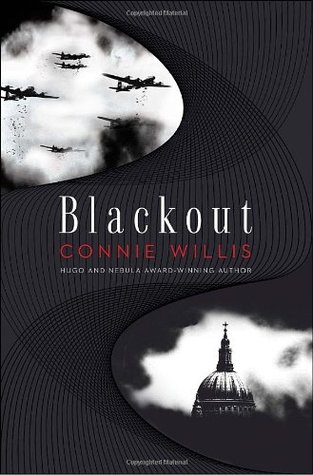
My book club wanted to read Blackout, another book in the series, set mainly during World War II. This is a book that you can pick up even if you haven’t read the earlier ones, as they’re loosely related. However, Blackout is only the beginning of a two-part story that is finished in the book All Clear, which I plan to start reading next.

The duology won the Hugo and Nebula Awards for Best Novel and the Locus Award for Best Science Fiction Novel.

Here is the blurb:

Oxford in 2060 is a chaotic place, with scores of time-traveling historians being sent into the past. Michael Davies is prepping to go to Pearl Harbor. Merope Ward is coping with a bunch of bratty 1940 evacuees and trying to talk her thesis adviser into letting her go to VE-Day. Polly Churchill’s next assignment will be as a shopgirl in the middle of London’s Blitz. But now the time-travel lab is suddenly canceling assignments and switching around everyone’s schedules. And when Michael, Merope, and Polly finally get to World War II, things just get worse. For there they face air raids, blackouts, and dive-bombing Stukas–to say nothing of a growing feeling that not only their assignments but the war and history itself are spiraling out of control. Because suddenly the once-reliable mechanisms of time travel are showing significant glitches, and our heroes are beginning to question their most firmly held belief: that no historian can possibly change the past.

I listened to Blackout as an audiobook (narrated by Katherine Kellgren), and while I enjoyed the book, I felt a little bogged down in some of the details. However, that is also one of the strong points of the book. The author does a wonderful job portraying the details of everyday life in WW2 England and interweaving that with the historical events. Being a terrible history student, I can’t say how accurate these details are, but it certainly feels authentic when reading it.

The characters feel well-drawn but are a bit frustrating to read about at times. I wanted to shout at them occasionally, but part of the story seems to be about how coincidence and accidents shaped history. The overall theme here relates to whether the past can be changed by these small events, and in the end, that question is still unanswered in this book.

In terms of pacing, I also felt like it took a while for the plot to emerge because there isn’t any real antagonist. Hitler is in the background of the plot, but the three main characters aren’t supposed to have any direct role in the war. Once things start to go wrong, it takes time for them to finally become convinced something is wrong and start to deal with it.

I did enjoy the book enough that I need to read the sequel though. None of the plot threads are resolved in this one, and I read that the publisher had split the original manuscript for the book into two volumes because of the length, so the author had intended it to be one long story.

Have you read Blackout or any of Connie Willis’s other books? Let me know in the comments.

Find more of my reviews here. And please follow the links to help support this blog.

Book Review – Dragonflight

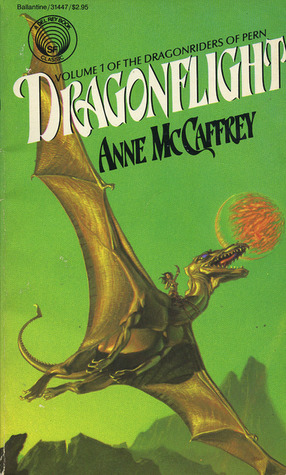
Sometimes I wonder if books I had read and loved when growing up would still stand up if I read them again now. One of my book clubs decided to read Dragonflight by Anne McCaffrey a few months ago, so I had a chance to evaluate that idea.

As a pre-teen and teenager, I read everything that Anne McCaffrey had written, including multiple re-reads of the Dragonriders of Pern series. I have to say that Dragonflight certainly still stands up as one of my favorite books of all time. While it is the first book in a series, it can also be read as a stand-alone.

Here is the blurb, which is a bit spoilery:

To the nobles who live in Ruatha Hold, Lessa is nothing but a ragged kitchen girl. For most of her life she has survived by serving those who betrayed her father and took over his lands. Now the time has come for Lessa to shed her disguise—and take back her stolen birthright.

But everything changes when she meets a queen dragon. The bond they share will be deep and last forever. It will protect them when, for the first time in centuries, Lessa’s world is threatened by Thread, an evil substance that falls like rain and destroys everything it touches. Dragons and their Riders once protected the planet from Thread, but there are very few of them left these days. Now brave Lessa must risk her life, and the life of her beloved dragon, to save her beautiful world. . .

The first sections of this book were originally published as novellas in Analog Science Fiction Magazine. The first of these, Weyr Search, won both the Hugo and the Nebula awards for Best Novella, making McCaffrey the first woman to win either award.

The story follows two main characters, with Lessa being the more dominant lead character. She came across as more prickly and less trusting than I remembered her to be. The plot moves quickly and introduces the reader to the telepathic dragons and the civilization that has adapted to Pern and the unique threat of Thread that falls from the sky.

I have always felt like the Dragonriders of Pern were more fantasy to me than science fiction, but on this re-read I do see how the science fiction aspects are woven in to hint at the underlying science background to the world of Pern to a greater extent than I remembered in this first book.

If you’ve never read anything by Anne McCaffrey, this is a wonderful book to start with. You can also continue with books 2 (Dragonquest) and 3 (The White Dragon) to complete the first section of the series. In my opinion, the eleventh book, All the Weyrs of Pern should have been the last book, as I felt like nothing else needed to be resolved after that ending. I read one or two in the series after that, but it just wasn’t the same world to me.

Read more of my reviews here. And please follow the links to help support this blog.

Book Review – This Is How You Lose the Time War

I picked this book up on a whim when I was looking for more stand-alone science fiction novels. I haven’t read a lot of time travel fiction, so why not explore a bit?

This is How You Lose the Time War was just nominated for a Hugo in the Best Novella category as well. I wasn’t familiar with authors Amal El-Mohtar or Max Gladstone prior to this. Please follow my Amazon affiliate links to help support this blog.

The way that this book is structured is unusual in that it is told from the perspectives of two opposing time-traveling agents, Red and Blue. Each one works for their faction to win a war that has raged across alternate timelines. The narrative switches between short scenes in which each agent finds a letter from their opposite, followed by the text of that letter.

I really like the way that this book was written as it was a fresh way to explore this type of concept. The language was beautiful but also a bit inaccessible at times. I’m sure I missed some of the references that the book makes.

The best part of this novel for me were the glimpses of each alternate reality through history, from Atlantis and prehistoric times to fishing villages and space battles. We never get to see much of each one, but the characters experienced just enough to draw me in.

Overall, I felt this book was too long for what it was trying to do. Part of the ending was easily predictable, but one aspect did surprise me. I think that it could have been just as effective though with fewer exchanges between Red and Blue.

This book won’t be for everyone, but as it is a novella, it’s fairly short. I’m glad I read it, but it isn’t going to be one of my favorites.

Read more of my reviews here.

Book Review – The City in the Middle of the Night

I am still very much behind on my book reviews, but since the Hugo award nominees were just announced, I thought I’d share my thoughts on those nominated works that I’ve already read. Please follow my Amazon affiliate links to help support this blog.

So this is a book review of The City in the Middle of the Night by Charlie Jane Anders. This book has been nominated for a Hugo for Best Novel. I listened to the audiobook version of this a couple of months ago. I reviewed the authors previous book, All the Birds in the Sky, here, and it was one of my favorite reads for 2019.

The premise in The City in the Middle of the Night is that people have colonized a planet that is tidally-locked. That means that it doesn’t rotate, so one side always faces toward the sun while the other side always faces away from it. This sets up a rather inhospitable environment where one side of the planet is too hot for people to survive, while the other is unbearably cold.

On this planet, humans have struggled to survive along the border between these two extremes. Making their lives even harder, dangerous alien life lives on the planet and the technology that was brought with the original colonists is breaking down and cannot be rebuilt.

The novel is told through the perspectives of two main characters. Sophie is a student in the city of Xiosphant where people’s circadian rhythms are regimented by the government in the absence of normal day-night cycles. She is in love with her best friend, Bianca, but when she takes the blame for her friend’s minor theft, she finds herself dragged from the safety of the city.

Abandoned and left for dead in the night outside the city, Sophie is beset upon by an alien called a Crocodile by the cityfolk. She surrenders herself to the monster, only to learn that the creatures are sentient as it helps her survive the cold and return to the city.

The second main character is Mouth, a member of the Resourceful Couriers, an illegal caravan that trades between cities, risking the dangers of the road. Mouth was once a member of the nomadic citizens, but all her people died tragically, leaving her alone to remember their culture. When she arrives in Xiosphant, she becomes obsessed with obtaining a citizen artifact from the palace. Her own story starts to overlap with that of Sophie and Bianca as Bianca joins a building rebellion and Sophie begins to engage again with the people of the city.

The plot is secondary to the relationships in this book, and while the narrative kept me interested, in the end, I found myself wanting more resolution in terms of the plot that had been building from the beginning. My opinions of each important character changed as I learned more about them and as they made their choices through the story, and they all felt very real and well drawn to me. I didn’t necessarily like them all, but I understood why they behaved the way that they did to each other.

I still enjoyed this book, but not as much as All the Birds in the Sky. It almost feels like the plot needs a sequel, but my understanding is that this is currently a stand-alone book.

Read more of my reviews here.

Previous Older Entries

Follow Blog via Email

Enter your email address to follow this blog and receive notifications of new posts by email.

Join 415 other subscribers