Book Review – The Saint of Bright Doors

The Saint of Bright Doors by Vajra Chandrasekera is a stand-alone novel that won the 2023 Nebula Award for Best Novel (paid link). It was also nominated for the 2024 Hugo Award for Best Novel. The premise sounded intriguing, so I picked it up. I have not read anything else by this author.

I read the e-book edition.

Here is the blurb:

Fetter was raised to kill, honed as a knife to cut down his sainted father. This gave him plenty to talk about in therapy.

He walked among invisible devils and anti-gods that mock the mortal form. He learned a lethal catechism, lost his shadow, and gained a habit for secrecy. After a blood-soaked childhood, Fetter escaped his rural hometown for the big city, and fell into a broader world where divine destinies are a dime a dozen.

Everything in Luriat is more than it seems. Group therapy is recruitment for a revolutionary cadre. Junk email hints at the arrival of a god. Every door is laden with potential, and once closed may never open again. The city is scattered with Bright Doors, looming portals through which a cold wind blows. In this unknowable metropolis, Fetter will discover what kind of man he is, and his discovery will rewrite the world.


I enjoyed the beginning of this book, but as the story evolved, I found myself getting less invested in what happened. The initial premise finds the narrator, Fetter, in the city of Luriat where he attends therapy sessions for people with special powers who thought they were destined for something great, only to later discover that they aren’t that special after all. I liked that idea and was entranced by the beginning of the story.

Fetter becomes caught up with a group of rebels who let him indulge his fascination with the Bright Doors that mysteriously appear throughout Luriat. I had hoped for more from this plot line, but the investigation of the doors fizzled as Fetter became obsessed with murdering the leader of a religious cult, who was coincidentally his father. Nothing about this goes well for him, and he has to abandon everything he built in Luriat.

I read that this book was described as part of the magical realism genre, and perhaps this genre is not for me. This is not the first time that I’ve struggled with a magical realism book (see my review of On Fragile Waves by E. Lily Yu here). The Saint of Bright Doors introduced many ideas and mysteries, but then never delivered with any explanation or greater purpose to any of it. Fetter’s reality shifts and becomes more surreal, but by the end of the book I didn’t care about what happened to him.

I would still consider reading another book by this author, but only if it was not considered magical realism.

You can find more of my book reviews here.

Musing on the Hugo, Nebula, World Fantasy, and Locus Awards

With the announcement of the finalists for the Locus Awards earlier this month, I thought I’d take some time to muse on why we pick out certain stories for recognition and to also relate some information on the awards that I follow (Hugo, Nebula, World Fantasy, Locus).

I recently read some of the nominees for the Nebula Awards so that I could vote for these (my pick for short story was The Sound of Children Screaming, which can be found here). I’ve also been reading some of the short stories that won Hugos and/or Nebulas in the past couple of years (Rabbit Test, If You Find Yourself Speaking to God, Address God with the Informal You).

So what’s with all these awards? What does each one mean? Who votes for them? And why does anyone care?

First of all, I think that it is important to provide recognition for outstanding talent and achievements in any field. The nomination and awards process also highlights a set of work and helps readers find stories that they might not have been otherwise aware of. Let’s go through each of these major awards and talk about the nomination process, categories, and other information about each one.

Hugo Awards.org media download site, Fair use, https://en.wikipedia.org/w/index.php?curid=60413579

Hugo Awards

The Hugo Awards have been awarded since 1953 and are named for Hugo Gernsback, the founder of the first classic magazine of science fiction, Amazing Stories. The current categories awarded include Best Novel (>40,000 words), Best Novella (17,500 to 40,000 words), Best Novelette (7,500 to 17,500 words), Best Short Story (<7500 words), Best Series, Best Related Work, Best Graphic Story, Best Dramatic Presentation (long and short forms), Best Semiprozine, Best Fanzine, Best Professional Editor, Best Professional Artist, Best Fan Artist, Best Fan Writer, Best Fancast, and Best Game or Interactive Work.

The Hugos are one of the most prestigious awards for the science fiction and fantasy genre. A list of nominees and winners can be found here. The Hugo Awards are presided over by the World Science Fiction Society. Attending and supporting members of the World Science Fiction Convention can nominate and vote on the awards. Even if you can’t attend the convention physically, you can purchase a supporting membership for voting privileges. The physical awards are announced and presented at that year’s World Science Fiction Convention (Worldcon), which is held generally around September and moves to a different city each year (2024 = Glasgow).

The Hugo Awards have been associated with some recent controversies. The Sad Puppies ran a campaign to nominate slates of works in reaction to the recent success of BIPOC authors and overall diversification in the genre. This led to several nominated authors declining to have their works considered (when included on the Sad Puppy slate), and No Award being selected in several categories where the Sad Puppy nominees dominated. The World Science Fiction Society made changes to the nomination and voting process in 2017.

More recently, the 2023 Hugo Awards became the source of another controversy when the voting statistics from the recent Worldcon held in Chengdu, China were released (scroll down to page 20 on the linked .pdf). Authors whose work may have been considered too political for Chinese censorship laws had received nominating votes, but were declared ineligible. Other votes from Chinese citizens were thrown out because they were considered to be following a slate suggested by a magazine (despite the rules not permitting this). Going forward, the Hugo administration has vowed to improve transparency in the process. You can find more details about what happened here.

The logo is from the following website: http://www.sfwa.org/ Nebula Awards official website, Fair use, https://en.wikipedia.org/w/index.php?curid=35826707

Nebula Awards

The Nebula Awards follow a similar process, with the main difference being that those who nominate and vote for these awards must be members of the Science Fiction and Fantasy Writers Association (SFWA). This is the professional organization for authors, artists, and editors in the science fiction and fantasy genres.

Categories for the Nebula Awards currently include Best Novel, Best Novella, Best Novelette, Best Short Story, and Best Game Writing (same word count requirements as for the Hugos). Other awards that are not technically Nebula Awards are also included in the Nebula process. These recently have included the Andre Norton Award for Outstanding Young Adult Science Fiction of Fantasy Book, the Ray Bradbury Award for Outstanding Dramatic Presentation, the Damon Knight Memorial Grand Master Award (for lifetime achievement), Author Emeritus (awarded posthumously for lifetime achievement), the Kevin O’Donnell Award for service to SFWA, and the Kate Wilhelm Solstice Award for significant impact on speculative fiction.

The Nebula Awards go through a similar round of nominations followed by voting, with the announcement and presentation of the winners at the SFWA Nebula Conference. This is usually in the spring and is held in the United States (2024 = Pasadena, California).

World Fantasy Awards

The World Fantasy Awards are a favorite of mine, I think because I lean more toward fantasy in my reading overall. These are administered by the World Fantasy Convention, which occurs annually in a different location around the world (2024 = Niagara Falls, New York). While the World Science Fiction Convention is a larger event with plenty for fans of the genre, the World Fantasy Convention is a professional event for authors, artists, editors, agents, and publishers. It can be a great place to meet people in the field for an upcoming author.

The World Fantasy Award nominees are partly selected by the attendees of the World Fantasy Convention, but also by a panel of judges who are professionals in the field. The categories for awards are Best Novel (>40,000 words), Best Novella (10,000 to 40,000 words), Best Short Fiction (<10,000 words), Best Collection (single author), Best Anthology (multiple authors), Best Artist, Special Award–Professional, Special Award–Non-Professional, Convention Award, and Life Achievement Award.

Controversy about the physical award arose in recent years. It had formerly been a bust of H.P. Lovecraft who has been criticized for his outspoken racism. The new award was changed to the one pictured in 2016.

Locus Awards

Designed by Francesca Myman, with art by Shaun Tan and presented by Locus Magazine. Source: Locus. – Original publication: Locus Magazine Immediate source: https://locusmag.com/2020/06/locus-awards-winners-2020/, Fair use, https://en.wikipedia.org/w/index.php?curid=68857244

The Locus Awards are put together by Locus Magazine, which is a monthly trade publication for the science fiction and fantasy genre. The awards are open for nomination by the public and the votes of subscribers to the magazine count twice. You can find the recent top 10 nominees here.

Categories for the Locus Awards include Best Science Fiction Novel, Best Fantasy Novel, Best Horror Novel, Best Young Adult Novel, Best First Novel, Best Novella, Best Novelette, Best Short Story, Best Anthology, Best Collection, Best Magazine, Best Publisher, Best Editor, Best Artist, Best Non-Fiction, and Best Illustrated and Art Book.

The winners are announced during an awards presentation that is associated with a weekend of readings and panels held in Oakland, California this year.

This has turned out to be a longer post than I thought it would be, but I hope it was helpful to explain some of the honors awarded in the science fiction and fantasy genres.

Have you voted for any of the awards? Which books have you read that won one of these awards? Let me know in the comments (above).

Book Review: Babel

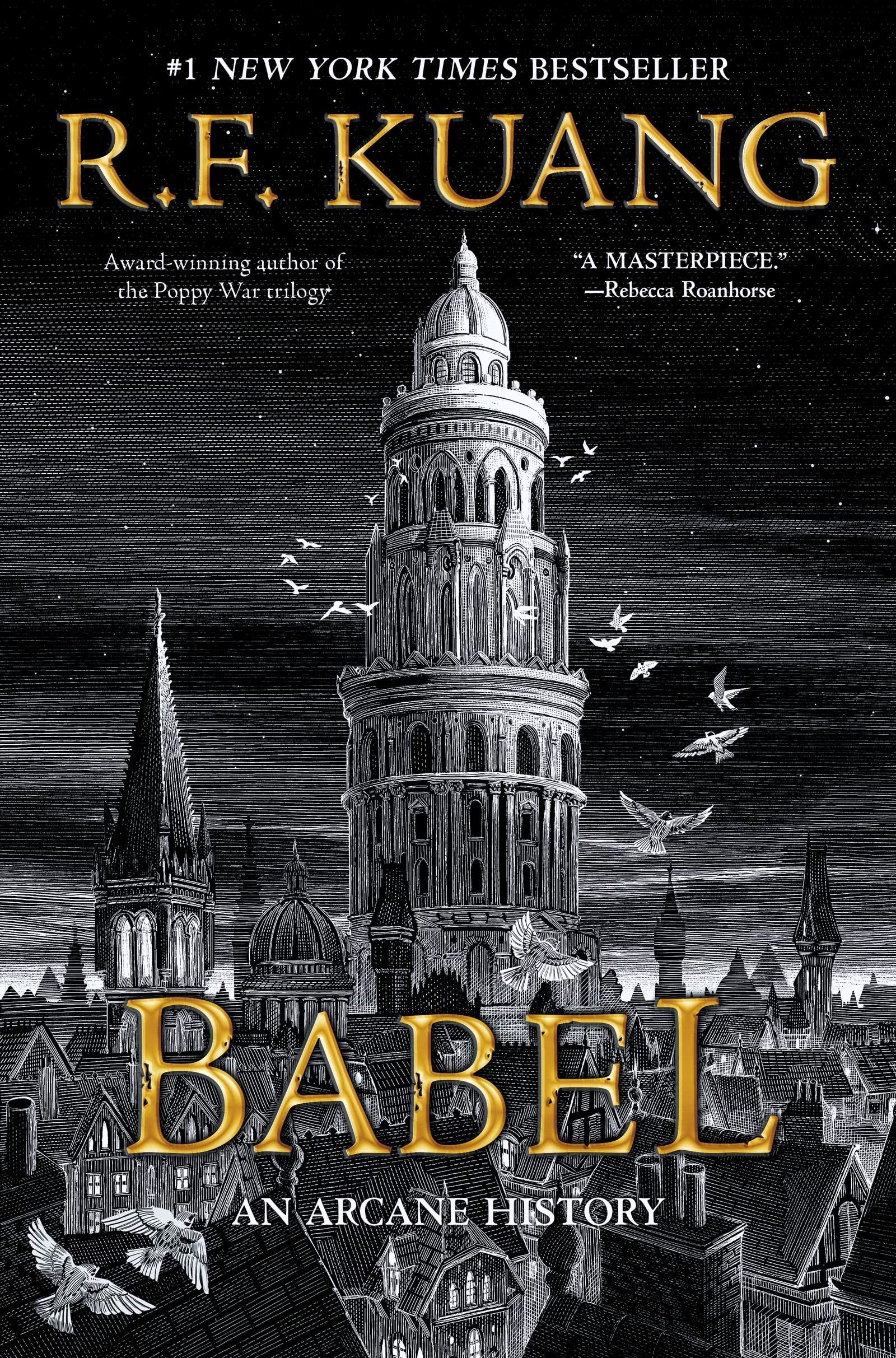
I have had The Poppy War (paid link) by R.F. Kuang sitting in my to-be-read pile for quite a while. But when one of my book clubs wanted to read the authors newest book, Babel (paid link), this ended up being my introduction to R.F. Kuang’s work. This novel has a longer version of the title, fully – Babel: or the Necessity of Violence: An Arcane History of the Oxford Translators’ Revolution. Babel won the Nebula award in 2022 for Best Novel.

I read this in hardcover.

Here is the blurb:

Traduttore, traditore: An act of translation is always an act of betrayal.

1828. Robin Swift, orphaned by cholera in Canton, is brought to London by the mysterious Professor Lovell. There, he trains for years in Latin, Ancient Greek, and Chinese, all in preparation for the day he’ll enroll in Oxford University’s prestigious Royal Institute of Translation—also known as Babel. The tower and its students are the world’s center for translation and, more importantly, magic. Silver-working—the art of manifesting the meaning lost in translation using enchanted silver bars—has made the British unparalleled in power, as the arcane craft serves the Empire’s quest for colonization.

For Robin, Oxford is a utopia dedicated to the pursuit of knowledge. But knowledge obeys power, and as a Chinese boy raised in Britain, Robin realizes serving Babel means betraying his motherland. As his studies progress, Robin finds himself caught between Babel and the shadowy Hermes Society, an organization dedicated to stopping imperial expansion. When Britain pursues an unjust war with China over silver and opium, Robin must decide . . .

Can powerful institutions be changed from within, or does revolution always require violence?


This book was quite long, but I despite the time they take to read, I often become enthralled with epic fantasy series and other stories with intricate details that require an intimidating number of pages to tell. Robin’s story in Babel develops slowly as he comes to live in England and starts his studies at Oxford. Yet it never became dull for me. The historical setting and the novel magic that combines precious metal with linguistics and translation were fresh and engaging.

The characters were diverse and well-drawn and didn’t always get along, leading to conflicts that helped to drive the book into darker places. This isn’t ultimately a happy story, but it does reach a resolution by the end and is a stand-alone novel.

The most interesting parts of this book for me were how it expanded upon the wrongs of colonialism and then used the story to make a point hinted at in the full title and specifically stated in the blurb — is violence ultimately necessary to enact revolutionary changes in society? Will peaceful campaigns always fail if the changes they seek are too divisive to the current culture? I read this book over the summer and have still been thinking about the questions it posed and examples from real history. So far, this is one of the best books I’ve read in 2023.

Have you read Babel or one of R.F. Kuang’s other books (paid link)? Let me know in the comments (above)!

Find more of my reviews here.

Book Review – All Clear

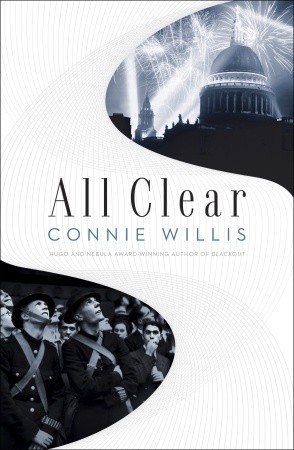
I just finished listening to the audiobook version of All Clear by Connie Willis, narrated by Katherine Kellgren. This book is the second part of one long story that started in Blackout, which I reviewed here, and is part of the author’s larger Oxford Time Travel book series. This duology won the Hugo, Locus, and Nebula awards.

Paid links help support this blog.

Here is the blurb:

In Blackout, award-winning author Connie Willis returned to the time-traveling future of 2060—the setting for several of her most celebrated works—and sent three Oxford historians to World War II England: Michael Davies, intent on observing heroism during the Miracle of Dunkirk; Merope Ward, studying children evacuated from London; and Polly Churchill, posing as a shopgirl in the middle of the Blitz. But when the three become unexpectedly trapped in 1940, they struggle not only to find their way home but to survive as Hitler’s bombers attempt to pummel London into submission.

Now the situation has grown even more dire. Small discrepancies in the historical record seem to indicate that one or all of them have somehow affected the past, changing the outcome of the war. The belief that the past can be observed but never altered has always been a core belief of time-travel theory—but suddenly it seems that the theory is horribly, tragically wrong.

Meanwhile, in 2060 Oxford, the historians’ supervisor, Mr. Dunworthy, and seventeen-year-old Colin Templer, who nurses a powerful crush on Polly, are engaged in a frantic and seemingly impossible struggle of their own—to find three missing needles in the haystack of history.

Told with compassion, humor, and an artistry both uplifting and devastating, All Clear is more than just the triumphant culmination of the adventure that began with Blackout. It’s Connie Willis’s most humane, heartfelt novel yet—a clear-eyed celebration of faith, love, and the quiet, ordinary acts of heroism and sacrifice too often overlooked by history.

I enjoyed this book more than the first half of the story in Blackout, probably because I was more invested in the characters by this point, and we see the characters figure out the mystery behind their problems with time travel. I think that the story worked better having the three main characters in contact with each other as well, rather than constantly missing each other as they did in Blackout.

The audio production of both these books was nicely done also. While this is quite a long story, my attention didn’t wander often while listening, which is more likely for me with an audiobook than a physical book.

The ending of the book brings everything to a satisfying close. I anticipated some of the outcomes but the author still threw in some facets that I hadn’t thought about. This is the kind of book that may be worth rereading once you know how it ends since there are many small pieces to the story that I likely missed on the first pass.

Have you read any of Connie Willis’s time travel books? Let me know in the comments.

Find more of my book reviews here.

Book Review – Blackout

I am not a huge history buff and it has been decades since I took a history class. However, I did delve into Connie Willis’s time travel books a few years ago with The Doomsday Book, set mostly during the spread of the Black Death in medieval England. I really enjoyed that story, but I don’t think I ever reviewed it here.

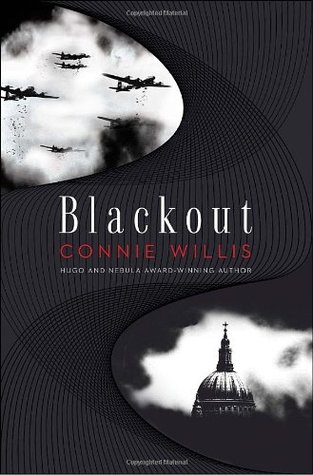
My book club wanted to read Blackout, another book in the series, set mainly during World War II. This is a book that you can pick up even if you haven’t read the earlier ones, as they’re loosely related. However, Blackout is only the beginning of a two-part story that is finished in the book All Clear, which I plan to start reading next.

The duology won the Hugo and Nebula Awards for Best Novel and the Locus Award for Best Science Fiction Novel.

Here is the blurb:

Oxford in 2060 is a chaotic place, with scores of time-traveling historians being sent into the past. Michael Davies is prepping to go to Pearl Harbor. Merope Ward is coping with a bunch of bratty 1940 evacuees and trying to talk her thesis adviser into letting her go to VE-Day. Polly Churchill’s next assignment will be as a shopgirl in the middle of London’s Blitz. But now the time-travel lab is suddenly canceling assignments and switching around everyone’s schedules. And when Michael, Merope, and Polly finally get to World War II, things just get worse. For there they face air raids, blackouts, and dive-bombing Stukas–to say nothing of a growing feeling that not only their assignments but the war and history itself are spiraling out of control. Because suddenly the once-reliable mechanisms of time travel are showing significant glitches, and our heroes are beginning to question their most firmly held belief: that no historian can possibly change the past.

I listened to Blackout as an audiobook (narrated by Katherine Kellgren), and while I enjoyed the book, I felt a little bogged down in some of the details. However, that is also one of the strong points of the book. The author does a wonderful job portraying the details of everyday life in WW2 England and interweaving that with the historical events. Being a terrible history student, I can’t say how accurate these details are, but it certainly feels authentic when reading it.

The characters feel well-drawn but are a bit frustrating to read about at times. I wanted to shout at them occasionally, but part of the story seems to be about how coincidence and accidents shaped history. The overall theme here relates to whether the past can be changed by these small events, and in the end, that question is still unanswered in this book.

In terms of pacing, I also felt like it took a while for the plot to emerge because there isn’t any real antagonist. Hitler is in the background of the plot, but the three main characters aren’t supposed to have any direct role in the war. Once things start to go wrong, it takes time for them to finally become convinced something is wrong and start to deal with it.

I did enjoy the book enough that I need to read the sequel though. None of the plot threads are resolved in this one, and I read that the publisher had split the original manuscript for the book into two volumes because of the length, so the author had intended it to be one long story.

Have you read Blackout or any of Connie Willis’s other books? Let me know in the comments.

Find more of my reviews here. And please follow the links to help support this blog.

Book Review – Dragonflight

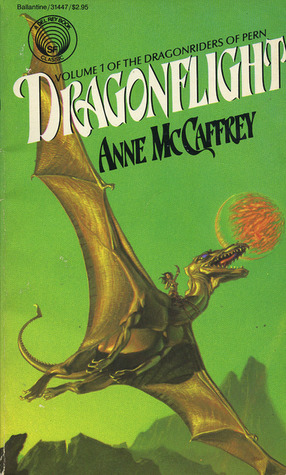
Sometimes I wonder if books I had read and loved when growing up would still stand up if I read them again now. One of my book clubs decided to read Dragonflight by Anne McCaffrey a few months ago, so I had a chance to evaluate that idea.

As a pre-teen and teenager, I read everything that Anne McCaffrey had written, including multiple re-reads of the Dragonriders of Pern series. I have to say that Dragonflight certainly still stands up as one of my favorite books of all time. While it is the first book in a series, it can also be read as a stand-alone.

Here is the blurb, which is a bit spoilery:

To the nobles who live in Ruatha Hold, Lessa is nothing but a ragged kitchen girl. For most of her life she has survived by serving those who betrayed her father and took over his lands. Now the time has come for Lessa to shed her disguise—and take back her stolen birthright.

But everything changes when she meets a queen dragon. The bond they share will be deep and last forever. It will protect them when, for the first time in centuries, Lessa’s world is threatened by Thread, an evil substance that falls like rain and destroys everything it touches. Dragons and their Riders once protected the planet from Thread, but there are very few of them left these days. Now brave Lessa must risk her life, and the life of her beloved dragon, to save her beautiful world. . .

The first sections of this book were originally published as novellas in Analog Science Fiction Magazine. The first of these, Weyr Search, won both the Hugo and the Nebula awards for Best Novella, making McCaffrey the first woman to win either award.

The story follows two main characters, with Lessa being the more dominant lead character. She came across as more prickly and less trusting than I remembered her to be. The plot moves quickly and introduces the reader to the telepathic dragons and the civilization that has adapted to Pern and the unique threat of Thread that falls from the sky.

I have always felt like the Dragonriders of Pern were more fantasy to me than science fiction, but on this re-read I do see how the science fiction aspects are woven in to hint at the underlying science background to the world of Pern to a greater extent than I remembered in this first book.

If you’ve never read anything by Anne McCaffrey, this is a wonderful book to start with. You can also continue with books 2 (Dragonquest) and 3 (The White Dragon) to complete the first section of the series. In my opinion, the eleventh book, All the Weyrs of Pern should have been the last book, as I felt like nothing else needed to be resolved after that ending. I read one or two in the series after that, but it just wasn’t the same world to me.

Read more of my reviews here. And please follow the links to help support this blog.

Follow Blog via Email

Enter your email address to follow this blog and receive notifications of new posts by email.

Join 415 other subscribers