Book Review – The Underground Railroad

Sometimes I decide to step back from genre fiction and read something more mainstream. Although part of the premise of The Underground Railroad by Colson Whitehead is fantastical, that is not what the book is about (paid links). This novel won several awards, including the 2017 Pulitzer Prize for Fiction and the 2016 National Book Award for Fiction. Read on below to find out more.

I read the hardcover edition of this.

Here is the blurb:

Cora is a slave on a cotton plantation in Georgia. Life is hell for all the slaves, but especially bad for Cora; an outcast even among her fellow Africans, she is coming into womanhood–where even greater pain awaits. When Caesar, a recent arrival from Virginia, tells her about the Underground Railroad, they decide to take a terrifying risk and escape. Matters do not go as planned–Cora kills a young white boy who tries to capture her. Though they manage to find a station and head north, they are being hunted.

In Whitehead’s ingenious conception, the Underground Railroad is no mere metaphor–engineers and conductors operate a secret network of tracks and tunnels beneath the Southern soil. Cora and Caesar’s first stop is South Carolina, in a city that initially seems like a haven. But the city’s placid surface masks an insidious scheme designed for its black denizens. And even worse: Ridgeway, the relentless slave catcher, is close on their heels. Forced to flee again, Cora embarks on a harrowing flight, state by state, seeking true freedom.

Like the protagonist of Gulliver’s Travels, Cora encounters different worlds at each stage of her journey–hers is an odyssey through time as well as space. As Whitehead brilliantly re-creates the unique terrors for black people in the pre-Civil War era, his narrative seamlessly weaves the saga of America from the brutal importation of Africans to the unfulfilled promises of the present day. The Underground Railroad is at once a kinetic adventure tale of one woman’s ferocious will to escape the horrors of bondage and a shattering, powerful meditation on the history we all share.


This was a hard book to read on an uncomfortable subject. This alternate history story set in the pre-Civil War American South features a literal underground railroad. Rather than providing a way for slaves to escape to freedom, this railroad is a literary device that the author uses to show the effects of slavery and racism in different constructed social settings.

Cora starts her journey as an enslaved young woman on a traditional southern plantation. The terrors on the Randall Plantation are those that are we’d expect from history. When the “kinder” of two brothers who own the plantation dies and Cora catches the eye of the remaining brother, her situation turns more imminently dangerous, impelling her to flee with the help of another slave.

In each destination that Cora reaches, she finds arguably better treatment. Yet none of these places treat her the same as the whites, even once she finds a freer community in the north. She has the illusion of freedom, but others are making decisions about what is best for her. She never has the agency that she should.

Throughout Cora’s story, she loses everyone who tries to help her. Cora doesn’t dwell too much on these losses and while this could make her characterization seem shallow, I felt like this was also a way for the author to make a specific point. Cora was originally abandoned by her mother, and given that families were torn apart in the slave trade, this was part of her life and something that she would have had no control over. It doesn’t seem fair that even when Cora finds some degree of safety and freedom, she still loses those she cares for, but her life is not fair because she cannot escape the color of her skin.

I’m glad that I read this book, but I don’t think that it added anything to what I personally already believe about human rights and discrimination. It was definitely a worthwhile book and offers a unique perspective on how racism has changed through history and how abolition hasn’t solved racial discrimination. I will probably donate this book to my local library so that other people can read it.

Have you read any books by Colson Whitehead? Is there another one that you would recommend I read? Let me know in the comments!

You can find more of my book reviews here.

Book Review – Dragonfly in Amber

I did manage to finish the second book in the Outlander series by Diana Gabaldon last week, Dragonfly in Amber. Hopefully this means that I’m on the way out of my March reading slump (paid links). This was also the audiobook version, narrated by Davina Porter.

You can find my review of book 1, Outlander, at this link.

I listened to the audiobook edition of this.

Here is the blurb:

From the author of Outlander… a magnificent epic that once again sweeps us back in time to the drama and passion of 18th-century Scotland…

For twenty years Claire Randall has kept her secrets. But now she is returning with her grown daughter to Scotland’s majestic mist-shrouded hills. Here Claire plans to reveal a truth as stunning as the events that gave it birth: about the mystery of an ancient circle of standing stones …about a love that transcends the boundaries of time …and about James Fraser, a Scottish warrior whose gallantry once drew a young Claire from the security of her century to the dangers of his ….

Now a legacy of blood and desire will test her beautiful copper-haired daughter, Brianna, as Claire’s spellbinding journey of self-discovery continues in the intrigue-ridden Paris court of Charles Stuart …in a race to thwart a doomed Highlands uprising …and in a desperate fight to save both the child and the man she loves….


The beginning of this book was not what I expected and introduced more time travel complications to the overarching storyline. It also framed the theme of this book – can the past be changed if one has foreknowledge of their outcome? Or is one helpless, pinned in place like the titular dragonfly? I won’t answer that question because you’ll have to read the book to find out.

This volume takes Claire and Jaime to France for most of the book. There, they use family connections and a little spycraft to try to stop the eventual uprising of the Scots against England that Claire knows is doomed to failure.

Claire and Jaime’s relationship evolves as they are faced with new challenges. I have to wonder how many different ways the author can pull them apart, have them question their love, and then have them reunite and reconcile. So far I don’t think she’s had a similar situation between them come up twice, but there are a lot of books to go.

The same narrator gave voice to this book, and I really like her portrayal of the characters. I wish that the books included a glossary or dramatis personae because sometimes I get the more minor Scots confused.

I don’t want to give any specific spoilers here, but I think that the ending of this volume was stronger than book 1. It provides enough resolution, but also sets up more mystery and tension about what happens next. I have already started the next book, Voyagers, which is almost 44 hours long, so look for my review of that one in about 6 weeks (paid link).

Have you read any of the Outlander books? How do the first two books compare to you? Let me know in the comments (above).

Find more of my book reviews here.

Book Review – Outlander

I have been meaning to read the Outlander series by Diana Gabaldon for many years, but it is daunting to start such a long series and I kept putting it off. My mother has read the whole thing (more than once) and I think she’s going to disown me if I don’t read it, so that was the final impetus for starting it. The first book is simply titled Outlander (paid links). I listened to the audiobook edition, narrated by Davina Porter.

The series has also inspired a show, and I’ve actually watched part of the first season. So going into this first book, I already had an idea of how the opening would go. Read on to see what I thought of the whole book.

I listened to the audiobook edition.

Here is the blurb:

The year is 1945. Claire Randall, a former combat nurse, is just back from the war and reunited with her husband on a second honeymoon when she walks through a standing stone in one of the ancient circles that dot the British Isles. Suddenly she is a Sassenach—an “outlander”—in a Scotland torn by war and raiding border clans in the year of Our Lord…1743.

Hurled back in time by forces she cannot understand, Claire is catapulted into the intrigues of lairds and spies that may threaten her life, and shatter her heart. For here James Fraser, a gallant young Scots warrior, shows her a love so absolute that Claire becomes a woman torn between fidelity and desire—and between two vastly different men in two irreconcilable lives.


I was surprised at how closely the beginning of the book followed what I already knew from the show. Of course, there are more details in the book, and this is certainly not a short novel. My own knowledge of English and Scottish history isn’t great at all, but I felt like I could follow along with the politics and intrigues. The author gives just enough historical knowledge to provide context for the story without becoming overwhelming.

The interplay between Jaime and Claire was interesting–the cultural differences between their two times cause a good amount of conflict. Claire is opinionated and headstrong while Jaime is a product of his time and tries to treat Claire accordingly. Their romance was well done though, moving from an arranged marriage to a place of mutual respect and then love. I’m curious to see how the author will keep their relationship fresh with at least nine more books left to go.

The narrator for the audiobook does a great job–both with the accents and with giving each character a distinctive voice.

My only criticism is that I felt that the ending of their time in Scotland was unsatisfying. Without giving too many specifics away, I wish that the final events of Jaime’s escape didn’t happen off-screen, only to have Claire hear about what happened later, particularly because I thought that it was weird for cows to be used in such a way.

I’m going to continue on with the series and am hoping to get through one book per month. Look for my review of book 2, Dragonfly in Amber, in March (paid link)!

Are you a fan of the Outlander books or the show? How far along in the books should I be before I start the show again? Let me know in the comments (above).

Find more of my reviews here.

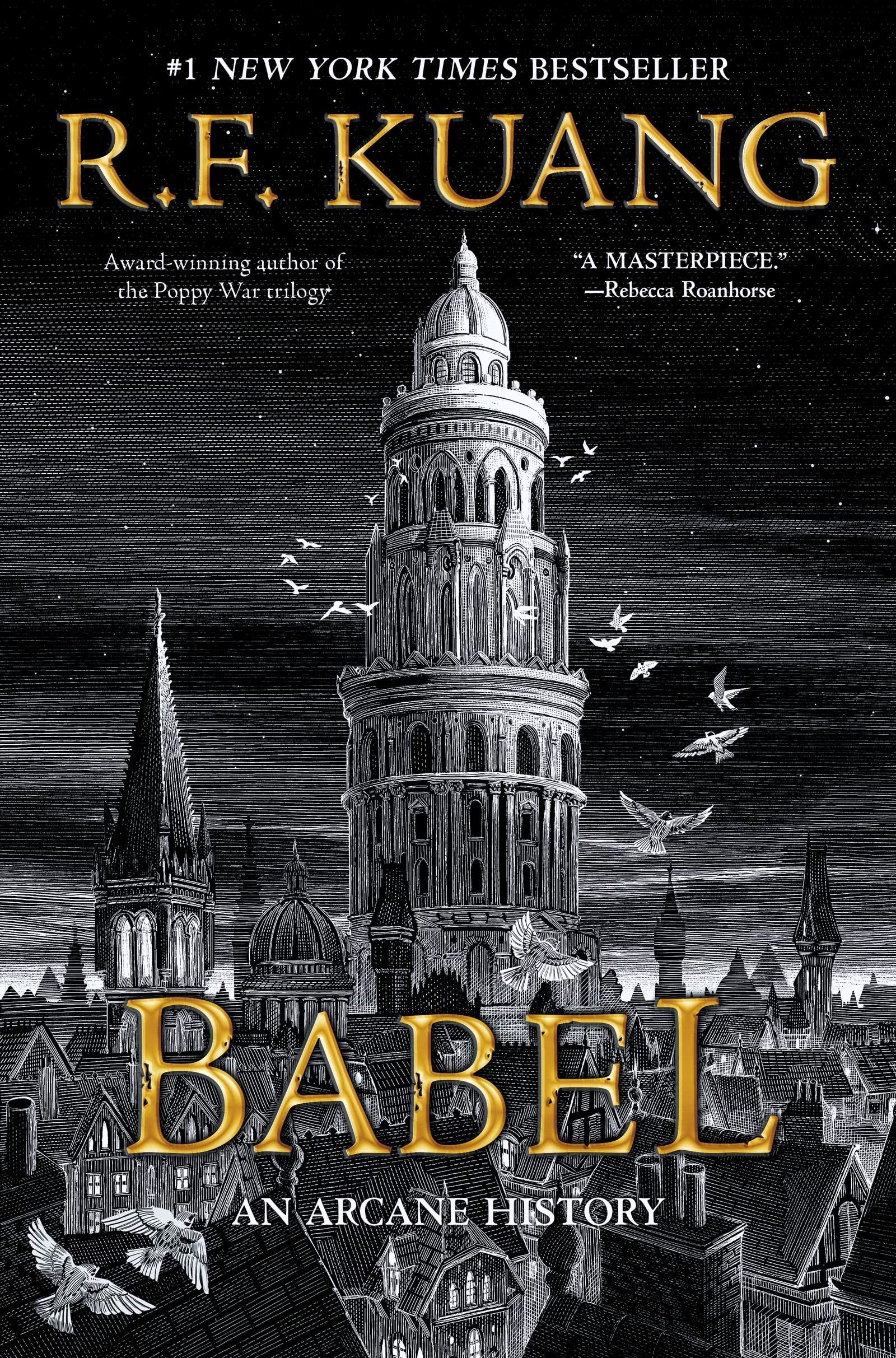
Book Review: Babel

I have had The Poppy War (paid link) by R.F. Kuang sitting in my to-be-read pile for quite a while. But when one of my book clubs wanted to read the authors newest book, Babel (paid link), this ended up being my introduction to R.F. Kuang’s work. This novel has a longer version of the title, fully – Babel: or the Necessity of Violence: An Arcane History of the Oxford Translators’ Revolution. Babel won the Nebula award in 2022 for Best Novel.

I read this in hardcover.

Here is the blurb:

Traduttore, traditore: An act of translation is always an act of betrayal.

1828. Robin Swift, orphaned by cholera in Canton, is brought to London by the mysterious Professor Lovell. There, he trains for years in Latin, Ancient Greek, and Chinese, all in preparation for the day he’ll enroll in Oxford University’s prestigious Royal Institute of Translation—also known as Babel. The tower and its students are the world’s center for translation and, more importantly, magic. Silver-working—the art of manifesting the meaning lost in translation using enchanted silver bars—has made the British unparalleled in power, as the arcane craft serves the Empire’s quest for colonization.

For Robin, Oxford is a utopia dedicated to the pursuit of knowledge. But knowledge obeys power, and as a Chinese boy raised in Britain, Robin realizes serving Babel means betraying his motherland. As his studies progress, Robin finds himself caught between Babel and the shadowy Hermes Society, an organization dedicated to stopping imperial expansion. When Britain pursues an unjust war with China over silver and opium, Robin must decide . . .

Can powerful institutions be changed from within, or does revolution always require violence?


This book was quite long, but I despite the time they take to read, I often become enthralled with epic fantasy series and other stories with intricate details that require an intimidating number of pages to tell. Robin’s story in Babel develops slowly as he comes to live in England and starts his studies at Oxford. Yet it never became dull for me. The historical setting and the novel magic that combines precious metal with linguistics and translation were fresh and engaging.

The characters were diverse and well-drawn and didn’t always get along, leading to conflicts that helped to drive the book into darker places. This isn’t ultimately a happy story, but it does reach a resolution by the end and is a stand-alone novel.

The most interesting parts of this book for me were how it expanded upon the wrongs of colonialism and then used the story to make a point hinted at in the full title and specifically stated in the blurb — is violence ultimately necessary to enact revolutionary changes in society? Will peaceful campaigns always fail if the changes they seek are too divisive to the current culture? I read this book over the summer and have still been thinking about the questions it posed and examples from real history. So far, this is one of the best books I’ve read in 2023.

Have you read Babel or one of R.F. Kuang’s other books (paid link)? Let me know in the comments (above)!

Find more of my reviews here.

Book Review – Crucible of Gold

As one of my reading goals for 2019, I planned to finish reading several book series that I had enjoyed but never completed. One such series was the Temeraire series by Naomi Novik, which brings dragons into the military of the Napoleonic Wars. I found that the sixth book (Tongues of Serpents) really dragged, so it took me a while to get back to the series.

Crucible of Gold is book #7 and picks up from the end of book #6 with Laurence and Temeraire still exiled to Australia. But this time, instead of wandering through a mainly uninhabited land, he is finally sent off to do something more interesting.

The French expansion now threatens Spain and Brazil, and Laurence is thought to be the best person to negotiate with the Tswana people as they threaten the Portuguese leaders in Rio. With Australia deemed reasonably close to Brazil, Laurence and Temeraire are sent off via ship for the New World. Of course, things do not go as expected, and one tragic event galvanized the story and made me truly wonder where it was going once more.

Eventually, they encounter the Inca and make a series of narrow escapes. The different human-dragon interactions and the variety of cultures was one of the more unique aspects of the story at this point. Much of the rest of the book involved travel from one place to the next, with a generally less focused story than the early books.

Interestingly, I found that starting with this book, each installment becomes less of a self-contained story. Each volume has a more indistinct ending and flows into the next book. At the same time, there are also larger jumps between places and time within one book.

This was still a better book than Tongues of Serpents and gave me hope for the last two books.

Find more of my book reviews here.

Follow Blog via Email

Enter your email address to follow this blog and receive notifications of new posts by email.

Join 415 other subscribers