Book Review – The Water Dancer

I had read The Water Dancer by Ta-Nehisi Coates about a year ago (yes, I’m that behind on reviews) and discussed it in a local book club. It turns out that it was also a selection in Oprah’s book club and debuted in the #1 spot on the New York Times bestseller list. I listened to the audiobook version, narrated by Joe Morton.

Paid links help to support this blog.

Here is the blurb:

Young Hiram Walker was born into bondage. When his mother was sold away, Hiram was robbed of all memory of her—but was gifted with a mysterious power. Years later, when Hiram almost drowns in a river, that same power saves his life. This brush with death births an urgency in Hiram and a daring scheme: to escape from the only home he’s ever known.

So begins an unexpected journey that takes Hiram from the corrupt grandeur of Virginia’s proud plantations to desperate guerrilla cells in the wilderness, from the coffin of the Deep South to dangerously idealistic movements in the North. Even as he’s enlisted in the underground war between slavers and the enslaved, Hiram’s resolve to rescue the family he left behind endures.

This is the dramatic story of an atrocity inflicted on generations of women, men, and children—the violent and capricious separation of families—and the war they waged to simply make lives with the people they loved. Written by one of today’s most exciting thinkers and writers, The Water Dancer is a propulsive, transcendent work that restores the humanity of those from whom everything was stolen.


It is hard for me to avoid comparing this book to Octavia Butler’s Kindred (which I had also recently read, a little before this book). The themes are similar, and though they could both be categorized as speculative fiction, the magical aspect is mostly a vehicle to address the horrors of slavery and racism in the Antebellum south.

I felt like this book lacked the tension of Kindred (although without that comparison, it was still a good read). Hiram struggles to understand his mysterious power and come to terms with his family relationships. Overall this was a gratifying read on some uncomfortable topics and is well-worth picking up.

Have you read either The Water Dancer or Kindred? How do you think the two books compare? Let me know in the comments (above).

Find more of my reviews here.

Book Review – Perilous Times

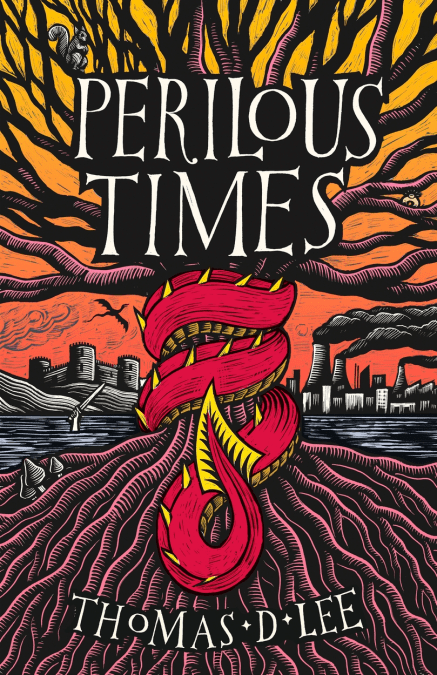
First up for my revived blog of book reviews is Perilous Times, the debut novel by Thomas D. Lee. I was given a copy of this book from Net Galley in exchange for an honest review. Read on for my thoughts on this mash-up of climate fiction and Arthurian legend.

Paid links help to support this blog.

Here is the blurb:

An immortal Knight of the Round Table faces his greatest challenge yet—saving the politically polarized, rapidly warming world from itself—in this slyly funny contemporary take on Arthurian legend.

Being reborn as an immortal defender of the realm gets awfully damn tiring over the years—or at least that’s what Sir Kay’s thinking as he claws his way up from beneath the earth, yet again.

Kay fought at Hastings, and at Waterloo, and in both World Wars. After a thousand years, he thought he was used to dealing with a crisis. But now he finds himself in a strange new world where oceans have risen, armies have been privatized, and half of Britain’s been sold to the Chinese. The dragon that’s running amok, that he can handle. The rest? He’s not so sure.

Mariam’s devoted her life to fighting what’s wrong with her country. But she’s just one ordinary person, up against a hopelessly broken system. So when she meets Kay, a figure straight out of legend, she dares to hope that the world’s finally found the savior it needs.

As the two quest through this strange land swarming with gangs, mercenaries, and talking squirrels, they realize that other ancient evils are afoot. Lancelot is back too–at the beck and call of immortal beings with a sinister agenda. And if their plans can’t be stopped, a dragon will be the least of the planet’s worries.

In perilous times like these, the realm doesn’t just need a knight. It needs a true leader.

Luckily, Excalibur lies within reach–and Kay’s starting to suspect that the hero fit to carry it is close at hand.


I had a hard time initially getting into this book because I think I was distracted by reading too many books at once, and not through any fault of the story or the writing. Once I made a commitment to this book, it was actually quite good, with a unique premise and themes of feminism, environmentalism, capitalism, and murky scientific ethics.

The two main characters, Kay and Mariam, cover most of the viewpoint chapters, and both are interesting. Kay is out of place, but is very self-aware of this, since he has woken up in different times every time England is in “peril”. Mariam takes all of the bizarre events in and accepts them pretty quickly (although it is hard to deny a dragon). They play off each other well and I was worried when they were separated at one point. But in the end, some secrets are revealed and this stand-alone novel wraps up with a satisfactory conclusion.

One other theme that I enjoyed that was woven into this book was that of what defines a hero. Kay is the “hero” from legend, but has tired of that role, while the true hero in the tale doesn’t see themself as doing anything beyond what any reasonable person should be doing.

Are you a fan of alternate Arthurian legend stories? Let me know in the comments (above)!

Find more of my reviews here.

Returning to Blogging and Reviews

I’m not sure what happened this year.

Everything was going well and then I just stopped writing posts and book reviews here. I guess I got busy with other priorities, but I don’t remember a specific event that occurred. Whatever it was, it is time to get back to writing posts and book reviews!

While I often feel like I haven’t been reading enough, when I look at my numbers on Goodreads, I have been steadily working through my to-be-read list for the year, despite the lack of posts about any of it.

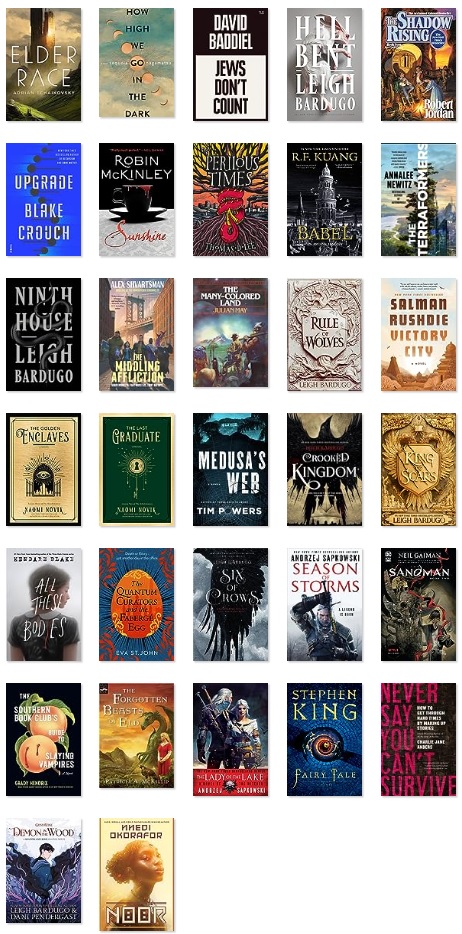
I had set an unreasonable goal to read 100 books this year when I usually fall somewhere between 40 to 50 books read per year. My current number stands at 32, so that puts me on track for my usual numbers. I would like to think that I’ll have time to read 2 books per week through the end of the year (giving me about 26 more), but that is likely wishful thinking. In any case, here is a peek at what I’ve already read this year:

Paid links help to support this blog.

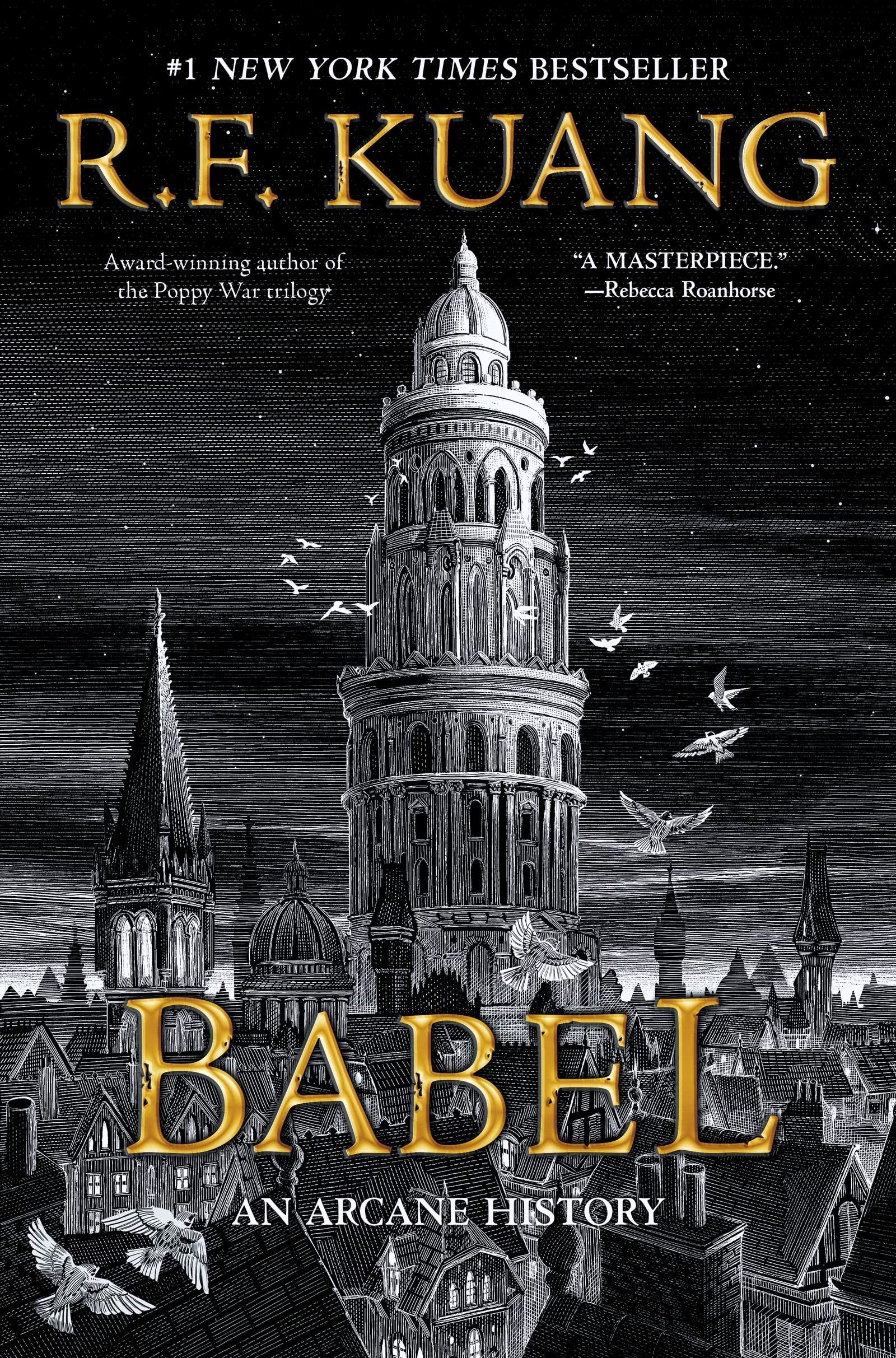
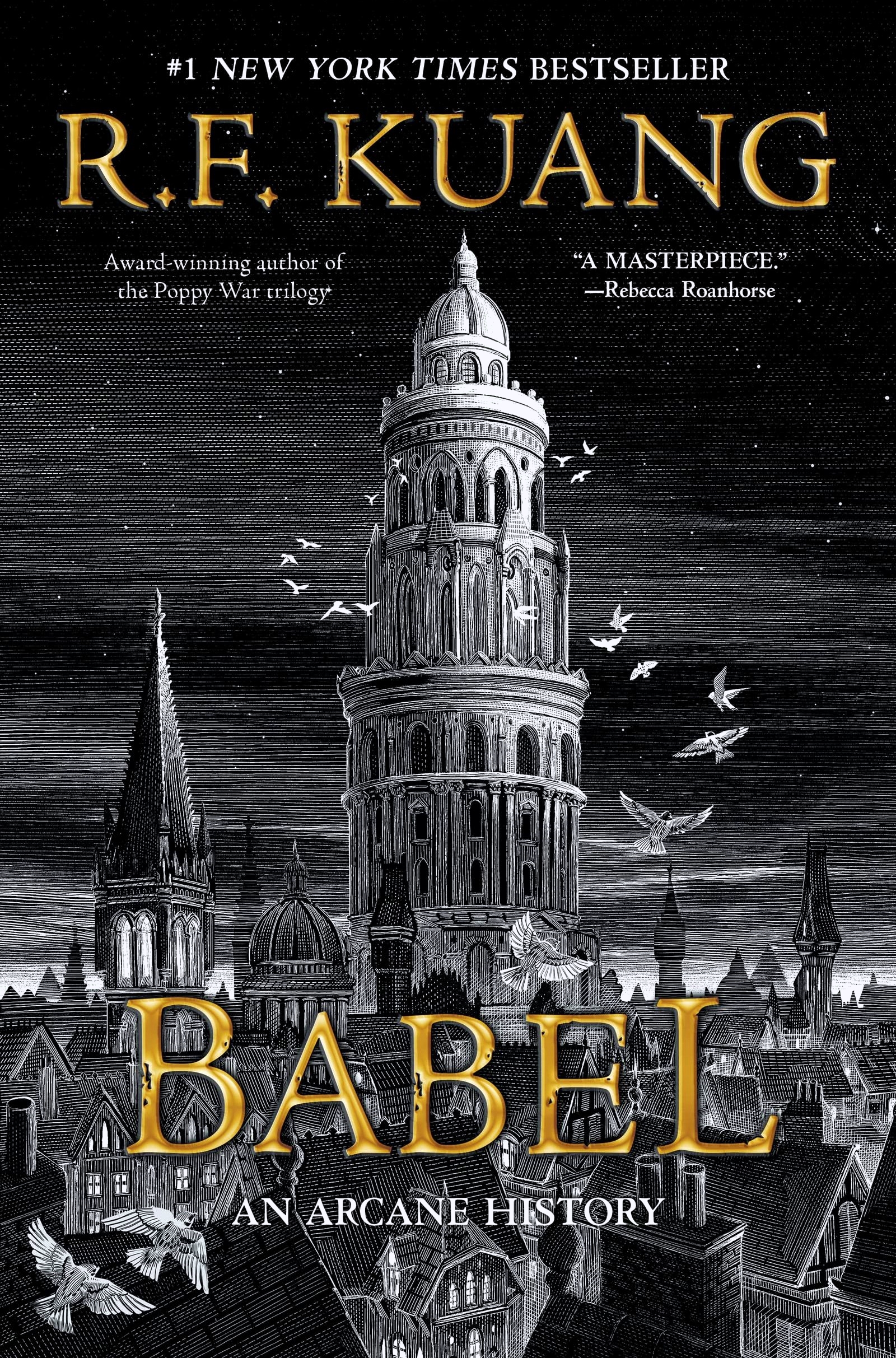
Some standouts to me included The Scholomance series by Naomi Novik, Leigh Bardugo’s Six of Crows and Alex Stern series, Babel by R.F. Kuang, and Elder Race by Adrian Tchaikovsky.

I’m currently reading Where the Crawdads Sing (physical book) by Delia Owens (not genre, I know) and The Fated Sky (audiobook) by Mary Robinette Kowal, the second book in the Lady Astronaut series.

Other books that I’m planning to read by the end of the year include The Adventures of Amina al-Sirafi by Shannon Chakraborty, Horse by Geraldine Brooks, Scorpica by G.R. Macallister, On Fragile Waves by E. Lily Yu, and The Road to Roswell by Connie Willis.

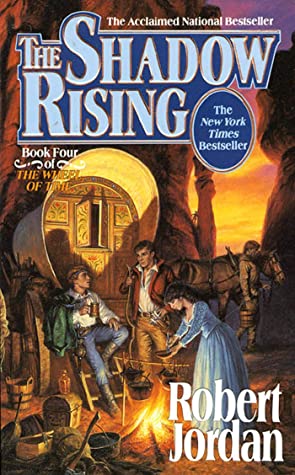
I also wanted to comment briefly on some series that I have been reading. It took me a LONG time to get through book 4 of The Wheel of Time by Robert Jordan. I’m planning to get back to that series, but I needed a break from it. I may start book 5, The Fires of Heaven, by the end of the year.

Another project that I have had was to read all of the original six Dune novels by Frank Herbert. I had finished the first three, but struggled to get into God Emperor of Dune. I’m going to try again, but also not until at least the end of the year.

The last ongoing series that I’ve been plodding through is the Demon Cycle by Peter V. Brett, but I can’t figure out why I keep putting this one off. I have really liked these books so far. I have the final two in the series, as well as another related work. Maybe I’m afraid to find out how it ends?

In 2023 we also got to see the release of Brandon Sanderson’s four “secret project” novels that he wrote during the lockdown portion of the pandemic. He broke the record for the most-funded Kickstarter in 2022, topping $41.7 million for the campaign.

I have mixed feelings about Sanderson’s writing (I liked one book but hated another series). But I appreciate his work ethic and his efforts to help other writers, so I contributed toward the Kickstarter and found myself with four more novels on my to-be-read list. I do intend to read them, but haven’t had time yet.

There are so many other books that I need to read and write about, but I’m going to stop now and get back to reading! How is your year of reading going? Let me know in the comments (above).

Book Review – The Cat Who Saved Books

I picked this novel up on a whim last year because it was about books and a cat, so what could be better? The Cat Who Saved Books by Sosuke Natsukawa has been translated from Japanese by Louise Heal Kawai, and I read this as an e-book.

Paid links help to support this blog.

Here is the blurb:

Bookish high school student Rintaro Natsuki is about to close the secondhand bookstore he inherited from his beloved bookworm grandfather. Then, a talking cat named Tiger appears with an unusual request. The feline asks for—or rather, demands—the teenager’s help in saving books with him. The world is full of lonely books left unread and unloved, and Tiger and Rintaro must liberate them from their neglectful owners. 

Their mission sends this odd couple on an amazing journey, where they enter different mazes to set books free. Through their travels, Tiger and Rintaro meet a man who leaves his books to perish on a bookshelf, an unwitting book torturer who cuts the pages of books into snippets to help people speed read, and a publishing drone who only wants to create bestsellers. Their adventures culminate in one final, unforgettable challenge—the last maze that awaits leads Rintaro down a realm only the bravest dare enter…

This was a fun and short read, but felt like a YA book rather than anything more serious. Rintaro follows Tiger through alternate worlds where he must figure out how to stop people who are mistreating books. Each of these challenges was interesting, but some of the people that Rintaro meets felt more like caricatures to me.

Tiger doesn’t take as active a role as I might have liked, but there are other secondary characters that help to liven up the plot. Given that this story was told by a Japanese author, I liked learning about some of the concepts from that culture that I was not aware of previously (like hikiomori).

Overall, I didn’t get quite as much out of this book as I would have liked, but it was also a quick read. I might pick up another book by this author in the future.

Have you read many books by authors from other cultures or backgrounds? Let me know in the comments (above).

Find more of my book reviews here.

Book Review – Season of Storms

Season of Storms by Andrzej Sapkowski is the most recently published book in The Witcher Saga, but is not the end chronologically. This could almost be read as a stand-alone novel and is set sometime after the initial relationships in the series have been formed, but before Geralt takes up his quest to protect Ciri. I listed to this as an audiobook, narrated by Peter Kenny.

Here are my reviews for the other books in the series:

Paid links help to support this blog.

Here is the blurb:

Geralt of Rivia. A witcher whose mission is to protect ordinary people from the monsters created with magic. A mutant who has the task of killing unnatural beings. He uses a magical sign, potions and the pride of every witcher — two swords, steel and silver. But what would happen if Geralt lost his weapons?

In this standalone novel, Geralt fights, travels and loves again, Dandelion sings and flies from trouble to trouble, sorcerers are scheming … and across the whole world clouds are gathering – the season of storms is coming…


This last Witcher novel was a lot of fun to read and felt like a side quest. Geralt’s two special swords are stolen and he suffers a series of unfortunate events as he attempts to find them. While this is a conceptually simple plot, other complications arise, both from the local politics, the attentions of a sorceress, and a mad wizard who lives by the credo that the ends justify the means.

One of the best parts of Sapkowski’s writing is how he comments on the genre while clearly being a fan of it and all that it entails. In this novel he jokes around with the trope of the magical or otherwise special sword, with Geralt refusing to ever truthfully answer what powers his swords have beyond functioning as well-made blades.

Those readers not familiar with this series could likely read this book with no prior knowledge of the story. But anyone who has read the main series will get more out of this one with multiple references to minor characters throughout the text. I suspect that at least one part of the ending won’t make sense unless you know how Geralt and Ciri’s story ends in The Lady of the Lake (although it doesn’t give anything away about that ending).

Overall, if you have read the rest of the books, Season of Storms is one not to miss. It mixes the best parts of Sapkowski’s craft while putting Geralt into ever-worsening situations with Dandelion, and taking new twists as he struggles to survive magic and monsters.

Have you read any of The Witcher Saga? What did you think? Let me know in the comments (above).

Find more of my reviews here.

Book Review – The Forgotten Beasts of Eld

Many years ago, I read The Riddle-Master of Hed series by Patricia A. McKillip, and I had loved that series. I don’t know why it took me so long to pick up another book this this author, but one of my book clubs recently chose to read this one – The Forgotten Beasts of Eld. This was a stand-alone fantasy tale and it won the World Fantasy Award for Best Novel in 1975.

Paid links help to support this blog.

Here is the blurb:

Young Sybel, the heiress of powerful wizards, needs the company of no-one outside her gates. In her exquisite stone mansion, she is attended by exotic, magical beasts: Riddle-master Cyrin the boar; the treasure-starved dragon Gyld; Gules the Lyon, tawny master of the Southern Deserts; Ter, the fiercely vengeful falcon; Moriah, feline Lady of the Night. Sybel only lacks the exquisite and mysterious Liralen, which continues to elude her most powerful enchantments.

But Sybel’s solitude is to be shattered when a desperate soldier arrives bearing a mysterious child. Soon Sybel will discover that the world of men is full of love, deceit, and the temptations of vast power.


Sybel’s story reads like a fairy tale and I found this book thoroughly enjoyable. I read the entire thing in about a day and a half! As much as she wants to stay out of the political events and conflicts, Sybel is inevitably drawn into them. Her loyalty is tested and torn as the characters evolve, and I liked how she is not without her flaws.

The “forgotten beasts” come from the mythology of this land but are very much present physically in the time and place of this story. They aren’t tame though, and they even cause Sybel trouble, for she has the ability to call them and communicate with them, but does not truly control them.

This is also a romance here, and while it is not the main emphasis of the story, I felt that it added to both the conflict and the resolution of the tale.

After reading The Forgotten Beasts of Eld, I want to go back to read more of Patricia A. McKillip’s work. Have you read any of her other works and have suggestions? Let me know in the comments (above).

Find more of my reviews here.
February Reading Wrap-Up

February was a tough reading month for me. I was busy with travel and work obligations, so I didn’t finish reading as many books as I had hoped. Looking back at the details, I only finished these two books below:

The Lady of the Lake is the 7th (publication order) book in The Witcher Saga and concluded the main plot of the series. You can read my review of this book here. The Forgotten Beasts of Eld by Patricia McKillip is a stand-alone novel that has a fairy-tale-like feel. I will be writing a full review of this one soon.

Despite only having finished these two books, I still managed a fair amount of reading. I just finished The Southern Book Club’s Guide to Slaying Vampires by Grady Hendrix today (technically in March). I’m also almost done with the second volume of The Sandman by Neil Gaiman and Season of Storms by Andrzej Sapkowski.

The Wheel of Time has become a slog, but I’m persisting on my read-through. I remember having this same experience when I read these books for the first time. The first three books were exciting and well-paced, and then The Shadow Rising (book 4) just drags. I am making progress though and I’m hoping to get a review done soon.

The only other book I’m reading is Perilous Times by Thomas D. Lee. This book is an advance copy that I received courtesy of Net Galley, but I have only just started this one.

For March, I’m going to finish The Shadow Rising, Season of Storms, and Perilous Times. After that, I’m not exactly sure what will be next, but you can see some of the options in the graphic below.

That’s it! What are you planning to read for March? Let me know in the comments (above).

Book Review – Master of Iron

Master of Iron by Tricia Levenseller is the second of two books in the Bladesmith duology. I reviewed the first book, Blade of Secrets, here. This is also one of the books I had picked up at New York Comic-Con 2022.

Paid links help to support this blog.

Here is the blurb:

Eighteen-year-old Ziva may have defeated a deadly warlord, but the price was almost too much. Ziva is forced into a breakneck race to a nearby city with the handsome mercenary, Kellyn, and the young scholar, Petrik, to find a powerful magical healer who can save her sister’s life.

When the events that follow lead to Ziva and Kellyn’s capture by an ambitious prince, Ziva is forced into the very situation she’s been dreading: magicking dangerous weapons meant for world domination.

The forge has always been Ziva’s safe space, a place to avoid society and the anxiety it causes her, but now it is her prison, and she’s not sure just how much of herself she’ll have to sacrifice to save Kellyn and take center stage in the very war she’s been trying to stop.


This book continued the story from Blade of Secrets and launches a new crisis where a power-hungry prince takes both Ziva and Kellyn captive and forces Ziva to create magical weapons for his growing army. The action in this book didn’t move as quickly as in Blade of Secrets and I had a harder time getting through it. Some of the plot felt too contrived to me.

The romance also felt like it stagnated, and despite Ziva and Kellyn being thrown together for so much of this book, Ziva’s lack of perception about their relationship made this a frustrating read. So overall, I didn’t like this second book as much as the first, but it did come to an exciting conclusion.

I feel like I’m seeing more duologies out there than I used to. Do you think that this is a good length for a story? Should they generally be combined into a single novel? Or could authors add more depth and get a trilogy out of it? Let me know in the comments (above).

Read more of my reviews here.

Book Review – Blade of Secrets

I had picked up Blade of Secrets by Tricia Levenseller at New York Comic-Con a few months ago because I enjoyed reading one of the her previous books – Warrior of the Wild. This book was the first of two in the Bladesmith fantasy/romance duology series.

Paid links help to support this blog.

Here is the blurb:

Eighteen-year-old Ziva prefers metal to people. She spends her days tucked away in her forge, safe from society and the anxiety it causes her, using her magical gift to craft unique weapons imbued with power.

Then Ziva receives a commission from a powerful warlord, and the result is a sword capable of stealing its victims’ secrets. A sword that can cut far deeper than the length of its blade. A sword with the strength to topple kingdoms. When Ziva learns of the warlord’s intentions to use the weapon to enslave all the world under her rule, she takes her sister and flees.

Joined by a distractingly handsome mercenary and a young scholar with extensive knowledge of the world’s known magics, Ziva and her sister set out on a quest to keep the sword safe until they can find a worthy wielder or a way to destroy it entirely.


This was an easy and fun read and moved quickly. Ziva was quickly established as a sympathetic protagonist because she suffers from pretty significant social anxiety and is only truly comfortable around her sister, Temra. Of course the story pushes her out from the comfort of her home and on a journey with her sister and two strangers.

The plot evolves and Ziva struggles to deal with new friends and family, only to be betrayed. The antagonist is relentless, but also holds some secrets that complicate everything. On top of that, Ziva wants to deny to her attraction to the handsome and irritating mercenary, Kellyn. He is only accompanying them for pay, after all.

This is not a complete story, so if you read this novel you will need to be prepared continue on to the second book, Master of Iron, to finish the tale. I will have a review of that one up next!

Have you read any of Tricia Levelseller’s books? Let me know in the comments (above).

Find more of my reviews here.

Book Review – The Lady of the Lake

I finally made it to the end. This is a book review for The Lady of the Lake, the final book (#7 publication order) in The Witcher Saga by Andrzej Sapkowski. I listened to this as an audiobook, narrated by Peter Kenny. There is another book that was published later (Season of Storms), but it is set earlier in the chronology and I’ll review that one soon.

There will be some spoilers in this review because I want to talk about the ending, but I’ll have a warning and some space before them.

You can find my reviews of the earlier books in this series here:

Paid links help to support this blog.

Here is the blurb:

After walking through the portal in the Tower of Swallows while narrowly escaping death, Ciri finds herself in a completely different world… an Elven world. She is trapped with no way out. Time does not seem to exist and there are no obvious borders or portals to cross back into her home world.

But this is Ciri, the child of prophecy, and she will not be defeated. She knows she must escape to finally rejoin the Witcher, Geralt, and his companions – and also to try to conquer her worst nightmare. Leo Bonhart, the man who chased, wounded and tortured Ciri, is still on her trail. And the world is still at war.


It becomes ever more clear through this series that the main character of this story is Ciri, and NOT Geralt the Witcher. She is immediately identified as the titular character in the opening of this book, and we spend a lot of time with her in this one.

Like in some of the earlier books, the author uses multiple points of view and jumps into other times (and even worlds) to tell this story. This method is incredibly effective during the Battle of Brenna, the final clash between the armies of Nilfgaard and the allied Northern Kingdoms. I can’t say that I’ve ever read anything quite like it, and even though you don’t get a play-by-play exchange of blows, the scenes relayed from the viewpoint of a field hospital, a messenger, and Jarre (the boy Ciri knew from her days in the temple, now an infantry soldier), gave a perspective that shows a chaotic struggle while also depicting the events with eerie clarity.

This novel did not give anything away in regard to how it would end, so I read with a lot of trepidation as I got further along. It was satisfying to finally see Ciri use her power as she tried to decide whether to embrace her destiny or fight it. For my spoiler-free review of the finale, I will say that I thought it was well-done and brought the character arcs to a gratifying end. From reading other reviews, it seems that this ending was very polarizing with readers. If you want to hear more of my thoughts on it, keep reading, but there will be…

Spoilers to follow!

Before I talk about the ending, I wanted to first comment on how Sapkowski brought Arthurian legend into these books. At first I was rather put off by this because I didn’t feel like his fantasy world should be so connected to our own. But then as I thought about this, I realized that Arthurian legend is NOT our world, but another mythic tale. So why couldn’t it be connected to The Witcher Saga like all of these other stories from eastern Europe that influenced the author’s writing?

I feel a little betrayed by the television show after reading this because it gave away the secret that Emhyr was Ciri’s father, Duny, so early. When that was revealed in the book, I don’t think that it had as much impact as it could have without already sort of knowing that.

The struggle at Vilgefortz’s castle was terrifying to read since I was convinced that every last one of Geralt’s band was going to die. And then they did (sadness!)… so when Sapkowski began to use the same story-telling technique with Geralt I was in agony. I had forgotten that ominous prophecy back at Caer Morhen about his death. But then… it was okay.

Or, do you think Geralt did actually die at the end? Were the unicorn and Ciri only able to help him reach an afterlife together with Yennefer?

If Ciri used her power to travel to another world, then what happened to the prophecy and her destiny? This is the only loose end that I felt was left too open-ended. Was she really able to scorn her destiny and move on? What happened to the prophecy that said the world would be covered in ice? I wish this aspect had come to more of a conclusion, but perhaps the answer to that is that Ciri was able to thwart destiny and then the prophecy became irrelevant in the end. What do you think? Let me know in the comments (above)!

Read more of my reviews here.

Previous Older Entries Next Newer Entries

Follow Blog via Email

Enter your email address to follow this blog and receive notifications of new posts by email.

Join 415 other subscribers