This is it – the third and final book of Naomi Novik’s Scholomance series! The Golden Enclaves (paid link) picks up immediately after that heart-stopping conclusion to book 2. You can find my other reviews for this series here:
The one thing you never talk about while you’re in the Scholomance is what you’ll do when you get out. Not even the richest enclaver would tempt fate that way. But it’s all we dream about, the hideously slim chance we’ll survive to make it out the gates and improbably find ourselves with a life ahead of us, a life outside the Scholomance halls.
And now the impossible dream has come true. I’m out, we’re all out–and I didn’t even have to turn into a monstrous dark witch to make it happen. So much for my great-grandmother’s prophecy of doom and destruction. I didn’t kill enclavers, I saved them. Me, and Orion, and our allies. Our graduation plan worked to perfection: we saved everyone and made the world safe for all wizards and brought peace and harmony to all the enclaves of the world.
Ha, only joking! Actually it’s gone all wrong. Someone else has picked up the project of destroying enclaves in my stead, and probably everyone we saved is about to get killed in the brewing enclave war on the horizon. And the first thing I’ve got to do now, having miraculously got out of the Scholomance, is turn straight around and find a way back in.
I did enjoy this final book in the Scholomance series overall. However, I felt like it wasn’t quite what I had hoped for in the conclusion to this series. Beware, there may be some spoilers below.
While it was interesting to see what the rest of the magical world looked like outside of the Scholomance, it also lacked the same feel as the earlier books. I enjoyed seeing how the students of magic went about their days with classes interspersed with danger. This story was bigger than the Scholomance, though. But then I also felt like it changed the relationship between El and Orion and made it less satisfying than it had been in book 2.
The revelation about the price that must be paid to create an enclave was one of the best parts of this book. The magicians knew they must keep the terrible truth secret, but at the same time, many of them knew and were willing to force someone to pay that price.
I felt that the final conclusion scenes of this series were rather anti-climactic. Both sides postured and threatened, and then nothing happened. They figured out a solution and then that was it. The tension that the prophecy and the danger had built fizzled for me. Still, I mostly enjoyed the series and will definitely be looking for Naomi Novik’s next book.
Have you read the Scholomance series (paid link)? What did you think about that ending? Let me know in the comments (above).
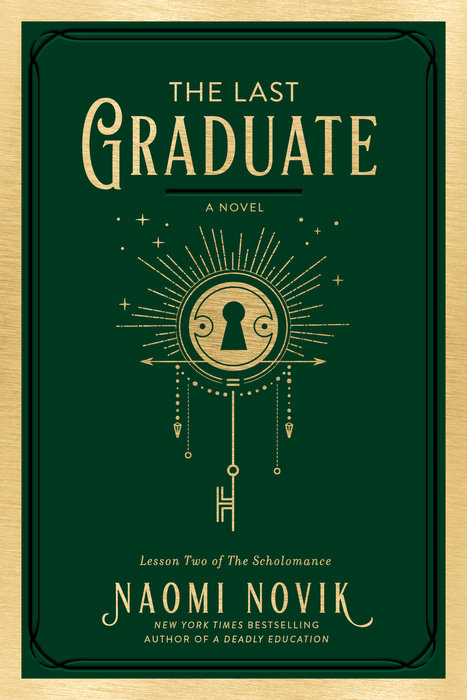
A budding dark sorceress determined not to use her formidable powers uncovers yet more secrets about the workings of her world in the stunning sequel to A Deadly Education, the start of Naomi Novik’s groundbreaking crossover series.
At the Scholomance, El, Orion, and the other students are faced with their final year—and the looming specter of graduation, a deadly ritual that leaves few students alive in its wake. El is determined that her chosen group will survive, but it is a prospect that is looking harder by the day as the savagery of the school ramps up. Until El realizes that sometimes winning the game means throwing out all the rules . . .
Another school year starts in this book and we follow El, Orion, and their friends as they try to study and survive it. In that respect it is similar to the first book, but this time El is less isolated while at the same time reluctantly put into a position of greater responsibility. The characters continued to shine in this volume as they navigate their way through the dangers of the Scholomance.
El is still haunted by the prophecy that claims she will become a danger to the enclaves, causing her to believe that she is destined to turn to dark magic. This was an intriguing part of the book to me since she has been clearly resisting the prophecy and I couldn’t see anything forcing her to make that change yet. However, I often distrust prophecies in fantasy fiction (thanks, Tad Williams).
This is definitely part of a series and would be difficult to pick up without reading A Deadly Education (paid link) first. The ending also ends on a devastating cliff-hanger, so be ready to start the last book, The Golden Enclaves (paid link), once you’re done.
Have you read any of the books in this series? Do you have a favorite series featuring a magic school? Let me know in the comments (above).
As the year approaches its end, I find myself looking back at the books I’ve read in 2023 and wondering how I became so distracted from my plan for the year.
Actually–this happens every year.
I start out with a shiny perfect to-be-read list that, while it might be overly ambitious, is orderly and logical. Then sometime around February I add books to the list. These might be a novel for one of my book clubs, a new release by a favorite author, or a book that was gifted to me. Other times I might read a description of a book that really grabs me and–wham! That’s another addition to the list.
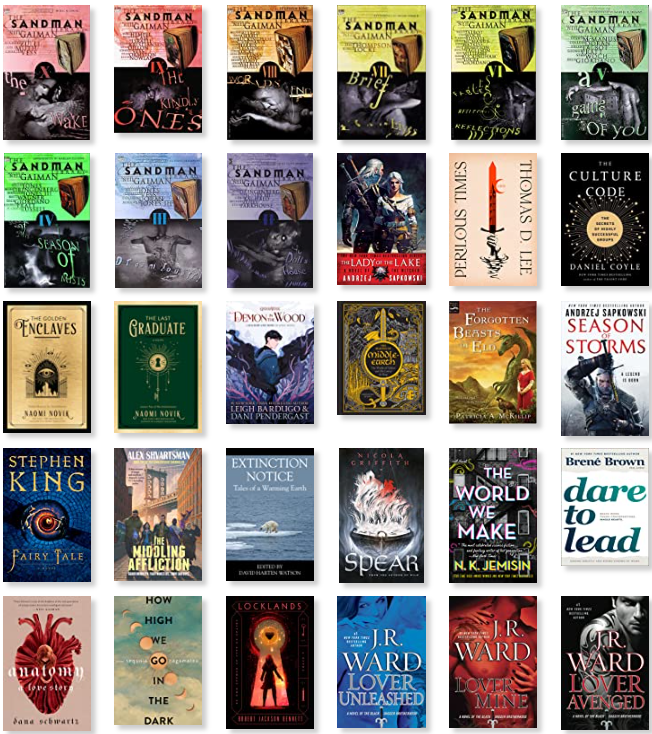
A portion of the books I had planned to read for 2023.
Thinking about my book chaos made me wonder how I decide which book I’m going to read next. Sometimes it’s a deadline – like for book club or a review that I want to coincide with a particular date. Often I’m just excited about delving into a particular story. Or I’ve been staring at a book that I left out on a table or desk.
I also have a dilemma when it comes to what format to read. I’m usually reading a physical book, an e-book, and an audiobook all at once. If I finish the audiobook, then I need another audiobook after that. And if I already have that book in another format, I’m not going to also buy it as an audiobook. Or for books that are part of a series, I try to keep with the same format for the whole thing, especially if I started it as an audiobook and really liked the narrator.
Books on my October to-be-read list.
I will try to control the chaos by breaking my gigantic to-be-read list down into smaller pieces by each month. Above is an example of those books sitting on my October list, none of which I have started and it is nearly the end of October. I do have to start On Fragile Waves for a book club meeting so that one will have priority over the others. Oh – and I should go back to look at the four books from my September list that I didn’t start yet.
As an aside, I did some work updating this blog last week and now you can see what I’m currently reading in the Goodreads widget in the sidebar on the right (scroll up from here).
How do you decide what to read next? Do you have an organized list? Do you stick to that? Let me know in the comments (above).
I have had A Deadly Education (paid link) by Naomi Novik on my to-be-read pile for a couple of years. She is an author who burst onto the scene with her Temeraire series (paid link) and then followed it up with two fairy-tale-inspired stand-alones–Uprooted and Spinning Silver (paid links)–and I have read them all. While I felt like the Temeraire series fizzled after the first three or four books, I loved both of the later stand-alones. A Deadly Education is the first book in a new series titled The Scholomance.
You can read my reviews of some of her other books here:
A Deadly Education is set at the Scholomance, a school for the magically gifted where failure means certain death (for real) — until one girl, El, begins to unlock its many secrets.
There are no teachers, no holidays, and no friendships, save strategic ones. Survival is more important than any letter grade, for the school won’t allow its students to leave until they graduate… or die! The rules are deceptively simple: Don’t walk the halls alone. And beware of the monsters who lurk everywhere.
El is uniquely prepared for the school’s dangers. She may be without allies, but she possesses a dark power strong enough to level mountains and wipe out millions. It would be easy enough for El to defeat the monsters that prowl the school. The problem? Her powerful dark magic might also kill all the other students.
At first glance, A Deadly Education sounds a lot like a Harry Potter knock-off. However, this magic school is far less forgiving than Hogwarts. The main character, El (short for Galadriel, courtesy of her hippie mother), is a loner with no friends and few resources who is struggling to stay on top of her courses while avoiding the monsters that search out vulnerable students. However, she is also haunted by a prophecy that foretold her to bring destruction upon the enclaves of magicians across the world. The school seems determined to help her along with this fate by revealing the most destructive and powerful spells to her, but El refuses to use the darker side of her power.
When El accidentally befriends Orion, the talented and privileged monster-slayer of the famed New York enclave of magicians, her fortunes shift. This relationship is integral to The Scholomance series, and Orion is not what El expected.
I loved this first book in The Schlomance! The school captured the essence of being a student of magic, but embraced the danger of learning those skills in a unique way. Additionally, the characters were diverse and interesting, with personalities that drew them into conflict beyond what the school already provided. I discussed this book in a local book club and we all decided that we must continue with the series.
Have you read The Scholomance series? What about other books by Naomi Novik? Let me know in the comments (above)?
Several years ago, I read Complications (paid link) by Atul Gawande, so I was vaguely familiar with this author when we began a checklist initiative at work last year. As part of that project, I received a copy of The Checklist Manifesto (paid link), which is a book that I’d been meaning to read anyway!
I read this in paperback.
Here is the blurb:
We live in a world of great and increasing complexity, where even the most expert professionals struggle to master the tasks they face. Longer training, ever more advanced technologies—neither seems to prevent grievous errors. But in a hopeful turn, acclaimed surgeon and writer Atul Gawande finds a remedy in the humblest and simplest of techniques: the checklist. First introduced decades ago by the U.S. Air Force, checklists have enabled pilots to fly aircraft of mind-boggling sophistication. Now innovative checklists are being adopted in hospitals around the world, helping doctors and nurses respond to everything from flu epidemics to avalanches. Even in the immensely complex world of surgery, a simple ninety-second variant has cut the rate of fatalities by more than a third.
In riveting stories, Gawande takes us from Austria, where an emergency checklist saved a drowning victim who had spent half an hour underwater, to Michigan, where a cleanliness checklist in intensive care units virtually eliminated a type of deadly hospital infection. He explains how checklists actually work to prompt striking and immediate improvements. And he follows the checklist revolution into fields well beyond medicine, from disaster response to investment banking, skyscraper construction, and businesses of all kinds.
An intellectual adventure in which lives are lost and saved and one simple idea makes a tremendous difference, The Checklist Manifesto is essential reading for anyone working to get things right.
I was already familiar with the concept of checklists in aviation from my training as a pilot and was vaguely aware that they were being used in surgical settings. This book outlined how the author worked with a group at his hospital to institute checklist use in pre-surgical preparation and for specific procedures in his hospital in order to reduce human error. The story of how he came to develop surgical checklists was helpful because he encountered some initial resistance to the project. Some skeptical surgeons were eventually convinced of the benefit, and Dr. Gawande explained how he had to learn what made a good checklist.
The author writes in a style that is very conversational and easy to follow, so this was a quick read for me. The concept of the checklist is so simple that it feels like an entire book about this is unnecessary. However, I found the story about how his team created this idea and implemented it to be valuable to read about. Dr. Gawande also explains some concepts that help make a checklist that people will actually use.
Have you read any of Atul Gawande’s books (paid link)? Do you use a checklist for anything in your professional or personal life? Let me know in the comments (above).
I have had The Poppy War (paid link) by R.F. Kuang sitting in my to-be-read pile for quite a while. But when one of my book clubs wanted to read the authors newest book, Babel (paid link), this ended up being my introduction to R.F. Kuang’s work. This novel has a longer version of the title, fully – Babel: or the Necessity of Violence: An Arcane History of the Oxford Translators’ Revolution. Babel won the Nebula award in 2022 for Best Novel.
I read this in hardcover.
Here is the blurb:
Traduttore, traditore: An act of translation is always an act of betrayal.
1828. Robin Swift, orphaned by cholera in Canton, is brought to London by the mysterious Professor Lovell. There, he trains for years in Latin, Ancient Greek, and Chinese, all in preparation for the day he’ll enroll in Oxford University’s prestigious Royal Institute of Translation—also known as Babel. The tower and its students are the world’s center for translation and, more importantly, magic. Silver-working—the art of manifesting the meaning lost in translation using enchanted silver bars—has made the British unparalleled in power, as the arcane craft serves the Empire’s quest for colonization.
For Robin, Oxford is a utopia dedicated to the pursuit of knowledge. But knowledge obeys power, and as a Chinese boy raised in Britain, Robin realizes serving Babel means betraying his motherland. As his studies progress, Robin finds himself caught between Babel and the shadowy Hermes Society, an organization dedicated to stopping imperial expansion. When Britain pursues an unjust war with China over silver and opium, Robin must decide . . .
Can powerful institutions be changed from within, or does revolution always require violence?
This book was quite long, but I despite the time they take to read, I often become enthralled with epic fantasy series and other stories with intricate details that require an intimidating number of pages to tell. Robin’s story in Babel develops slowly as he comes to live in England and starts his studies at Oxford. Yet it never became dull for me. The historical setting and the novel magic that combines precious metal with linguistics and translation were fresh and engaging.
The characters were diverse and well-drawn and didn’t always get along, leading to conflicts that helped to drive the book into darker places. This isn’t ultimately a happy story, but it does reach a resolution by the end and is a stand-alone novel.
The most interesting parts of this book for me were how it expanded upon the wrongs of colonialism and then used the story to make a point hinted at in the full title and specifically stated in the blurb — is violence ultimately necessary to enact revolutionary changes in society? Will peaceful campaigns always fail if the changes they seek are too divisive to the current culture? I read this book over the summer and have still been thinking about the questions it posed and examples from real history. So far, this is one of the best books I’ve read in 2023.
Sometimes I take a break from my usual fantasy and science fiction genre books to read something more mainstream. Several people had recommended Where the Crawdads Sing (paid link) by Delia Owens to me. When a copy was passed along to me, I figured it would make for some good vacation reading.
I read this in paperback.
Here is the blurb:
For years, rumors of the “Marsh Girl” haunted Barkley Cove, a quiet fishing village. Kya Clark is barefoot and wild; unfit for polite society. So in late 1969, when the popular Chase Andrews is found dead, locals immediately suspect her.
But Kya is not what they say. A born naturalist with just one day of school, she takes life’s lessons from the land, learning the real ways of the world from the dishonest signals of fireflies. But while she has the skills to live in solitude forever, the time comes when she yearns to be touched and loved. Drawn to two young men from town, who are each intrigued by her wild beauty, Kya opens herself to a new and startling world—until the unthinkable happens.
In Where the Crawdads Sing, Owens juxtaposes an exquisite ode to the natural world against a profound coming of age story and haunting mystery. Thought-provoking, wise, and deeply moving, Owens’s debut novel reminds us that we are forever shaped by the child within us, while also subject to the beautiful and violent secrets that nature keeps.
The story asks how isolation influences the behavior of a young woman, who like all of us, has the genetic propensity to belong to a group. The clues to the mystery are brushed into the lush habitat and natural histories of its wild creatures.
This book drew me in immediately with both a sympathetic main character in Kya (who is abandoned by her mother and usually ignored and sometimes abused by her father), alternating with a murder mystery set at a later date. It is clear that these two stories will intersect, but even toward the end I was left guessing about the details until nearly the last page.
Kya is deeply in tune with nature in her surrounding marsh in North Carolina, feeling closer to the gulls and marsh grasses than she is to people. However, that doesn’t completely prevent her from seeking out companionship, leading to the conflicts within her tale. Even though Kya is alone for many scenes, the story is never dull.
Where the Crawdads Sing is a coming of age tale, a romance, a book about nature and the environment, and a story about isolation, prejudice, and belonging. While it wasn’t science fiction or fantasy, I really enjoyed this one and would recommend it for anyone who is looking for well-written prose, compelling characters, and a journey through our natural world.
Have you read this book or seen the recent movie (paid link)? I’m planning to watch it in the next week or two. Let me know in the comments (above).
I wasn’t aware of this book until it was chosen by one of my book clubs. And once I heard the title, I had to make sure I picked it up. The Southern Book Club’s Guide to Slaying Vampires was the first book by Grady Hendrix that I’ve read.
Paid links help to support this blog.
Here is the blurb:
Patricia Campbell had always planned for a big life, but after giving up her career as a nurse to marry an ambitious doctor and become a mother, Patricia’s life has never felt smaller. The days are long, her kids are ungrateful, her husband is distant, and her to-do list is never really done. The one thing she has to look forward to is her book club, a group of Charleston mothers united only by their love for true-crime and suspenseful fiction. In these meetings, they’re more likely to discuss the FBI’s recent siege of Waco as much as the ups and downs of marriage and motherhood.
But when an artistic and sensitive stranger moves into the neighborhood, the book club’s meetings turn into speculation about the newcomer. Patricia is initially attracted to him, but when some local children go missing, she starts to suspect the newcomer is involved. She begins her own investigation, assuming that he’s a Jeffrey Dahmer or Ted Bundy. What she uncovers is far more terrifying, and soon she–and her book club–are the only people standing between the monster they’ve invited into their homes and their unsuspecting community.
I really liked this book and enjoyed how the southern women managed to harness their homemaking skills to take on a vampire. At the same time, the societal pressures upon them also make for some internal strife between the different women.
This vampire was slightly different than others that I’d read about in other fiction, but I like that in vampire fiction. It keeps me guessing about what the vampire can actually do and what his weaknesses are. Ultimately, this novel didn’t add anything revolutionary to the vampire fiction out there, but it was still an entertaining story. I’d consider picking up another book by this author sometime soon.
Have you read any books by Grady Hendrix? Which do you recommend? Let me know in the comments (above).
I was excited to read The Middling Affliction, book #1 in the Conradverse Chronicles by Alex Shvartsman because the author is a local friend who I have helped with some proofreading and other feedback (not on this book though). I previously reviewed one of his other books (Eridani’s Crown) over here.
Paid links help to support this blog.
Here is the blurb:
What would you do if you lost everything that mattered to you, as well as all means to protect yourself and others, but still had to save the day? Conrad Brent is about to find out.
Conrad Brent protects the people of Brooklyn from monsters and magical threats. The snarky, wisecracking guardian also has a dangerous secret: he’s one in a million – literally.
Magical ability comes to about one in every 30,000 and can manifest at any age. Conrad is rarer than this, however. He’s a middling, one of the half-gifted and totally despised. Most of the gifted community feels that middlings should be instantly killed. The few who don’t flat out hate them still aren’t excited to be around middlings. Meaning Conrad can’t tell anyone, not even his best friends, what he really is.
Conrad hides in plain sight by being a part of the volunteer Watch, those magically gifted who protect their cities from dangerous, arcane threats. And, to pay the bills, Conrad moonlights as a private detective and monster hunter for the gifted community. Which helps him keep up his personal fiction – that he’s a magical version of Batman. Conrad does both jobs thanks to charms, artifacts, and his wits, along with copious amounts of coffee. But little does he know that events are about to change his life…forever.
When Conrad discovers the Traveling Fair auction house has another middling who’s just manifested her so-called powers on the auction block, he’s determined to save her, regardless of risk. But what he finds out while doing so is even worse – the winning bidder works for a company that’s just created the most dangerous chemical weapon to ever hit the magical community.
Before Conrad can convince anyone at the Watch of the danger, he’s exposed for what he really is. Now, stripped of rank, magical objects, friends and allies, Conrad has to try to save the world with only his wits. Thankfully though, no one’s taken away his coffee.
This book lived up to the playful description in the blurb and was a lot of fun to read! While Eridani’s Crown took place in an alternate world fantasy, The Middling Affliction is a solid piece of urban fantasy set in the New York City area. Like last week’s review of Perilous Times, this story looks at what it takes to be a hero, and that is not always defined by what magic or super powers one possesses.
The plot jumps from one action scene to another and the stakes keep going up with each new problem that Conrad encounters. I particularly enjoyed how Conrad manages to maintain the charade of using magic when he cannot actually do this (and then when a certain thing happens in the plot, he is in a unique place to act empathetically).
This was also a quick read (240 pages) for me and felt light-hearted (despite the dire occurrences). I’m definitely going to pick up the second book (Kakistocracy) soon!
Do you read much urban fantasy? What is your favorite series? Let me know in the comments (above).
The Shadow Rising is book #4 (of 14) in The Wheel of Time series by Robert Jordan. I had originally read up through book #7 or 8 as they were published, but then I felt like I wasn’t remembering enough of the details between the books and put them aside to read the entire series once it was complete.
Reviews of other books in the series:
Book 1 – The Eye of the World (I skipped reviewing this one)
The seals of Shayol Ghul are weak now, and the Dark One reaches out. The Shadow is rising to cover humankind.
In Tar Valon, Min sees portents of hideous doom. Will the White Tower itself be broken?
In the Two Rivers, the Whitecloaks ride in pursuit of a man with golden eyes, and in pursuit of the Dragon Reborn.
In Cantorin, among the Sea Folk, High Lady Suroth plans the return of the Seanchan armies to the mainland.
In the Stone of Tear, the Lord Dragon considers his next move. It will be something no one expects, not the Black Ajah, not Tairen nobles, not Aes Sedai, not Egwene or Elayne or Nynaeve.
Against the Shadow rising stands the Dragon Reborn…..
Goodreads tells me that this book took me nine months to read. I was also distracted by reading other books, but still — this one was a slog. This aligned with my memory of my previous read through and was not a surprise though.
In any case, Rand al’Thor has proclaimed himself as the Dragon Reborn, but then all of the characters sit around in the Stone of Tear and wait for him to do something. Rand is uncertain how to proceed and doesn’t trust anyone and so he debates his options for much of the book before anything more interesting happens.
Once our viewpoint characters leave Tear, the story picks up again, with Rand having to prove himself again to a different group of people. Meanwhile, many of our core characters split up and embark on different threads of the plot. Nynaeve and Elayne continue to ignore the rules of the White Tower while they pretend to be full Aes Sedai, and Egwene learns about a new aspect of her own power.
The scenes with Perrin are some of my favorite, but I felt like these also dragged on for longer than they needed to. I had to put the series down for a few months, but still plan on reading on soon.
Did you read the entire series? Did the pacing slow down for you at a specific point? Let me know in the comments (above).