Nebula Award Winners 2023

The Nebula Awards for 2023 were announced this past weekend. Here are the winners (paid links)!

Best Novel

The Saint of Bright Doors by Vajra Chandrasekera (Tordotcom)

Best Novella

Linghun by Ai Jiang (Dark Matter Ink)

Best Novelette

The Year Without Sunshine by Naomi Kritzer (Uncanny 11-12/23)

Best Short Story

Tantie Merle and the Farmhand 4200 by R.S.A. Garcia (Uncanny 7-8/23)

Best Game Writing

Baldur’s Gate 3 – Adam Smith, Adrienne Law, Baudelaire Welch, Chrystal Ding, Ella McConnell, Ine Van Hamme, Jan Van Dosselaer, John Corcoran, Kevin VanOrd, Lawrence Schick, Martin Docherty, Rachel Quirke, Ruairí Moore, Sarah Baylus, Stephen Rooney, Swen Vincke (Larian Studios)

The Ray Bradbury Nebula Award for Outstanding Dramatic Presentation

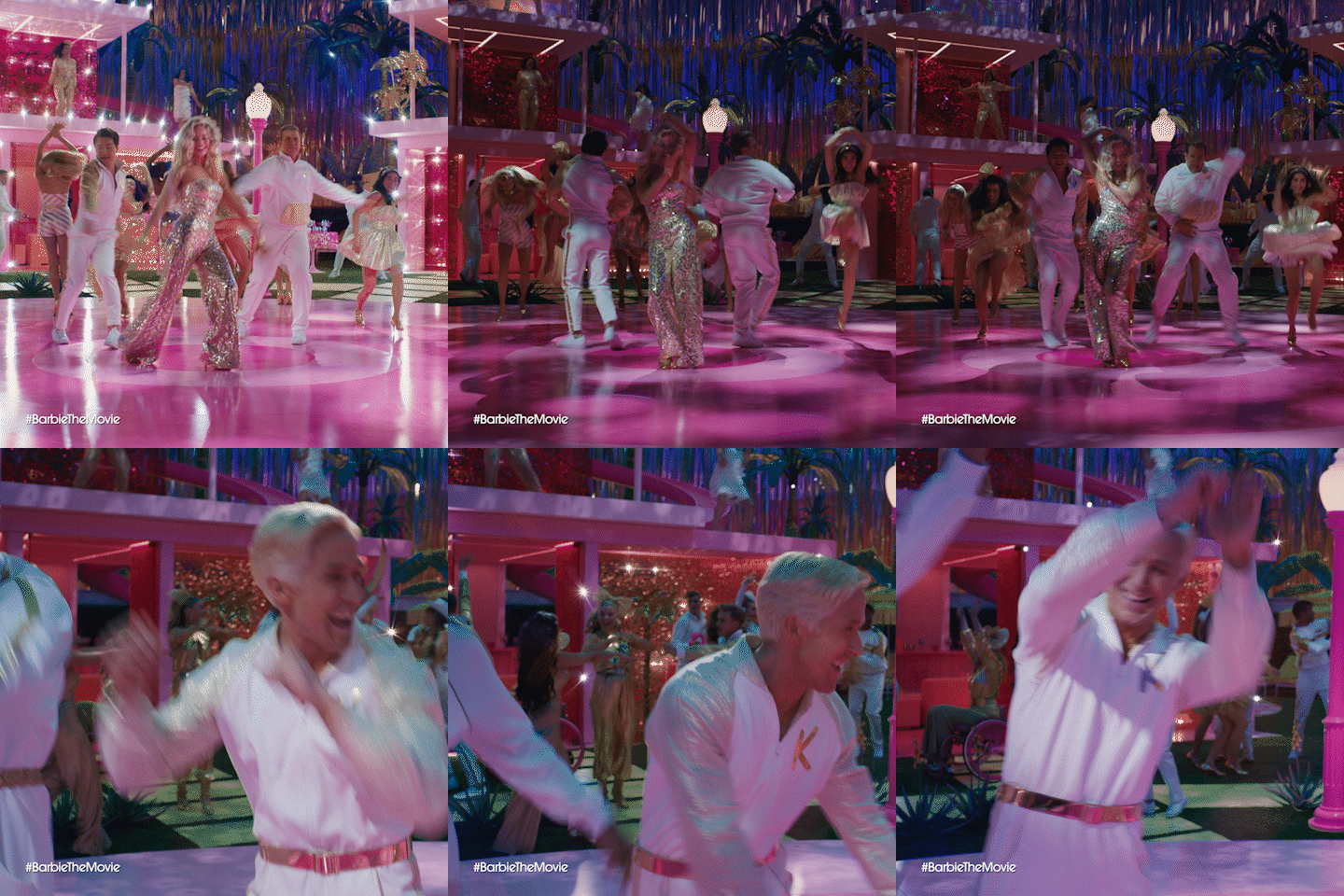
Barbie – Greta Gerwig, Noah Baumbach (Warner Bros., Heyday Films, LuckyChap Entertainment)

The Andre Norton Nebula Award for Middle Grade and Young Adult Fiction

To Shape a Dragon’s Breath by Moniquill Blackgoose (Del Rey)

Some additional awards and honors were also presented:

The SFWA Damon Knight Memorial Grand Master Award – Susan Mary Cooper

The SFWA Infinity Award – Tanith Lee

The Kate Wilhelm Solstice Award – Jennell Jaquays

The Kevin O’Donnell, Jr. Service to SFWA Award – James Hosek

For more information on the Nebulas and other awards in fantasy and science fiction, you can read my recent post here.

Have you read any of the books and stories that won? I’m still working through Baldur’s Gate 3 and loved the Barbie movie. Share your thoughts in the comments (above).

Book Review – The Fires of Heaven

The Fires of Heaven is the fifth book in The Wheel of Time series by author Robert Jordan (paid links). I have been slowing working through this series and I’m determined to finish it this time. Read on to see what I thought of this one.

Here are my reviews of the other books in the series:

I read the e-book edition of this.

Here is the blurb:

Prophesized to defeat the Dark One, Rand al’Thor, the Dragon Reborn, has upset the balance of power across the land. Shaido Aiel are on the march, ravaging everything in their path. The White Tower’s Amyrlin has been deposed, turning the Aes Sedai against one another. The forbidden city of Rhuidean is overrun by Shadowspawn.

Despite the chaos swirling around him, Rand continues to learn how to harness his abilities, determined to wield the One Power–and ignoring the counsel of Moiraine Damodred at great cost.


This book picks up with our main characters still scattered around Randland (Note that I’m embracing the term Randland for the world of the Wheel of Time because I’m not sure that Robert Jordan ever gave a name to the world that he created). Siuan and Leane have fled the tower with Min and Logain and the two stilled Aes Sedai work to keep their focus on new goals to put off the despondency that usually follows the loss of the use of the One Power.

Rand has embraced his role as The Dragon Reborn, or the Car’a’carn by the Aiel legends. Yet, the Aiel are split and Rand must lead the Aiel out of the Waste in pursuit of the rebellious Shaido before they cause too much destruction. This theme of political strike and division continues throughout the book. The White Tower is divided, and the realms of Amadicia, Altara, and Andor are plagued by unrest and uncertain leadership. Rand is forced to work with his enemies as he continues to learn how to use his power and fight the Forsaken.

Despite all the events of this book, I felt like the pace has slowed and several scenes could have been easily cut to make this a shorter book. We do see the main characters develop and grow – Rand, Mat, Egwene, and Nynaeve, in particular. Like in the earlier volumes, the end of this book concludes with conflict – both a larger battle and a smaller duel. I’ve already started the next book, Lord of Chaos.

Have you read The Wheel of Time? What do you think of the pacing? Let me know in the comments (above).

Find more of my reviews here.

May 2024 Reading Wrap Up

May was not a great reading month for me. I had a lot of other things going on, as well as some travel. You’d think that I’d have more time to read while traveling, but it doesn’t always work out that way. I lose focus while reading on a plane and then at my destination, I’m often too tired to stay up reading. And while I bring my headphones, I find that I never put on my audiobook in these situations.

The month of May didn’t quite go according to plan. I only finished one book, The Fires of Heaven (Book 5 in The Wheel of Time) by Robert Jordan. I’ll have a review of this one up soon (paid links).

I read two short stories for one of my book clubs. We have pivoted to a short story format for a few months to see if we can get more people attending the discussions. These are the two stories that we recently read, and you can find them for free at these links:

I’m still listening to the audiobook of Voyager (Outlander #3) by Diana Gabaldon, and I should finish this in the next two weeks (14 hours to go). I also started to read Iron Flame by Rebecca Yarros, the second book in the Empyrean series. You can find my review of the first book, Fourth Wing, here. Since I was traveling and had my Kindle with me, I started on the 6th Wheel of Time book immediately after finishing the 5th with Lord of Chaos (paid links).

For June, here are some of the books that I’m planning to read after I finish the ones above.

Let’s see how much I can read as the summer starts!

What are you planning to read next? Let me know in the comments (above).

Musing on the Hugo, Nebula, World Fantasy, and Locus Awards

With the announcement of the finalists for the Locus Awards earlier this month, I thought I’d take some time to muse on why we pick out certain stories for recognition and to also relate some information on the awards that I follow (Hugo, Nebula, World Fantasy, Locus).

I recently read some of the nominees for the Nebula Awards so that I could vote for these (my pick for short story was The Sound of Children Screaming, which can be found here). I’ve also been reading some of the short stories that won Hugos and/or Nebulas in the past couple of years (Rabbit Test, If You Find Yourself Speaking to God, Address God with the Informal You).

So what’s with all these awards? What does each one mean? Who votes for them? And why does anyone care?

First of all, I think that it is important to provide recognition for outstanding talent and achievements in any field. The nomination and awards process also highlights a set of work and helps readers find stories that they might not have been otherwise aware of. Let’s go through each of these major awards and talk about the nomination process, categories, and other information about each one.

Hugo Awards.org media download site, Fair use, https://en.wikipedia.org/w/index.php?curid=60413579

Hugo Awards

The Hugo Awards have been awarded since 1953 and are named for Hugo Gernsback, the founder of the first classic magazine of science fiction, Amazing Stories. The current categories awarded include Best Novel (>40,000 words), Best Novella (17,500 to 40,000 words), Best Novelette (7,500 to 17,500 words), Best Short Story (<7500 words), Best Series, Best Related Work, Best Graphic Story, Best Dramatic Presentation (long and short forms), Best Semiprozine, Best Fanzine, Best Professional Editor, Best Professional Artist, Best Fan Artist, Best Fan Writer, Best Fancast, and Best Game or Interactive Work.

The Hugos are one of the most prestigious awards for the science fiction and fantasy genre. A list of nominees and winners can be found here. The Hugo Awards are presided over by the World Science Fiction Society. Attending and supporting members of the World Science Fiction Convention can nominate and vote on the awards. Even if you can’t attend the convention physically, you can purchase a supporting membership for voting privileges. The physical awards are announced and presented at that year’s World Science Fiction Convention (Worldcon), which is held generally around September and moves to a different city each year (2024 = Glasgow).

The Hugo Awards have been associated with some recent controversies. The Sad Puppies ran a campaign to nominate slates of works in reaction to the recent success of BIPOC authors and overall diversification in the genre. This led to several nominated authors declining to have their works considered (when included on the Sad Puppy slate), and No Award being selected in several categories where the Sad Puppy nominees dominated. The World Science Fiction Society made changes to the nomination and voting process in 2017.

More recently, the 2023 Hugo Awards became the source of another controversy when the voting statistics from the recent Worldcon held in Chengdu, China were released (scroll down to page 20 on the linked .pdf). Authors whose work may have been considered too political for Chinese censorship laws had received nominating votes, but were declared ineligible. Other votes from Chinese citizens were thrown out because they were considered to be following a slate suggested by a magazine (despite the rules not permitting this). Going forward, the Hugo administration has vowed to improve transparency in the process. You can find more details about what happened here.

The logo is from the following website: http://www.sfwa.org/ Nebula Awards official website, Fair use, https://en.wikipedia.org/w/index.php?curid=35826707

Nebula Awards

The Nebula Awards follow a similar process, with the main difference being that those who nominate and vote for these awards must be members of the Science Fiction and Fantasy Writers Association (SFWA). This is the professional organization for authors, artists, and editors in the science fiction and fantasy genres.

Categories for the Nebula Awards currently include Best Novel, Best Novella, Best Novelette, Best Short Story, and Best Game Writing (same word count requirements as for the Hugos). Other awards that are not technically Nebula Awards are also included in the Nebula process. These recently have included the Andre Norton Award for Outstanding Young Adult Science Fiction of Fantasy Book, the Ray Bradbury Award for Outstanding Dramatic Presentation, the Damon Knight Memorial Grand Master Award (for lifetime achievement), Author Emeritus (awarded posthumously for lifetime achievement), the Kevin O’Donnell Award for service to SFWA, and the Kate Wilhelm Solstice Award for significant impact on speculative fiction.

The Nebula Awards go through a similar round of nominations followed by voting, with the announcement and presentation of the winners at the SFWA Nebula Conference. This is usually in the spring and is held in the United States (2024 = Pasadena, California).

World Fantasy Awards

The World Fantasy Awards are a favorite of mine, I think because I lean more toward fantasy in my reading overall. These are administered by the World Fantasy Convention, which occurs annually in a different location around the world (2024 = Niagara Falls, New York). While the World Science Fiction Convention is a larger event with plenty for fans of the genre, the World Fantasy Convention is a professional event for authors, artists, editors, agents, and publishers. It can be a great place to meet people in the field for an upcoming author.

The World Fantasy Award nominees are partly selected by the attendees of the World Fantasy Convention, but also by a panel of judges who are professionals in the field. The categories for awards are Best Novel (>40,000 words), Best Novella (10,000 to 40,000 words), Best Short Fiction (<10,000 words), Best Collection (single author), Best Anthology (multiple authors), Best Artist, Special Award–Professional, Special Award–Non-Professional, Convention Award, and Life Achievement Award.

Controversy about the physical award arose in recent years. It had formerly been a bust of H.P. Lovecraft who has been criticized for his outspoken racism. The new award was changed to the one pictured in 2016.

Locus Awards

Designed by Francesca Myman, with art by Shaun Tan and presented by Locus Magazine. Source: Locus. – Original publication: Locus Magazine Immediate source: https://locusmag.com/2020/06/locus-awards-winners-2020/, Fair use, https://en.wikipedia.org/w/index.php?curid=68857244

The Locus Awards are put together by Locus Magazine, which is a monthly trade publication for the science fiction and fantasy genre. The awards are open for nomination by the public and the votes of subscribers to the magazine count twice. You can find the recent top 10 nominees here.

Categories for the Locus Awards include Best Science Fiction Novel, Best Fantasy Novel, Best Horror Novel, Best Young Adult Novel, Best First Novel, Best Novella, Best Novelette, Best Short Story, Best Anthology, Best Collection, Best Magazine, Best Publisher, Best Editor, Best Artist, Best Non-Fiction, and Best Illustrated and Art Book.

The winners are announced during an awards presentation that is associated with a weekend of readings and panels held in Oakland, California this year.

This has turned out to be a longer post than I thought it would be, but I hope it was helpful to explain some of the honors awarded in the science fiction and fantasy genres.

Have you voted for any of the awards? Which books have you read that won one of these awards? Let me know in the comments (above).

Book Review – On Fragile Waves

I’ve been reading some long books lately. That means that I haven’t finished anything new to review this week, so I’m going to my dwindling backlog for this post.

I read On Fragile Waves by E. Lily Yu last year for one of my book clubs (paid link). It was described as magical realism, which is a sub-genre that I’m not terribly familiar with. I listened to the audiobook, narrated by Jeed Saddy.

I listened to the audiobook edition.

Here is the blurb:

Firuzeh and her brother Nour are children of fire, born in an Afghanistan fractured by war. When their parents, their Atay and Abay, decide to leave, they spin fairy tales of their destination, the mythical land and opportunities of Australia.

As the family journeys from Pakistan to Indonesia to Nauru, heading toward a hope of home, they must rely on fragile and temporary shelters, strangers both mercenary and kind, and friends who vanish as quickly as they’re found.

When they arrive in Australia, what seemed like a stable shore gives way to treacherous currents. Neighbors, classmates, and the government seek their own ends, indifferent to the family’s fate. For Firuzeh, her fantasy worlds provide some relief, but as her family and home splinter, she must surface from these imaginings and find a new way.


The concept of this book sounded interesting enough, and I’m always open to reading diverse perspectives. However, the story told in this book never truly captured my interest and contained very little in the way of fantastical elements. The magical realism aspect comes in when Firuzeh’s friend dies on the journey, but continues to visit Firuzeh and speak to her. I was disappointed overall, and while I finished the book, I don’t even remember how it ended now.

The writing in the book was good and I’d consider reading a different book by the same author. The narrator was easy to listen to and I think that I might not have been able to finish a print or e-book version of this novel. Sometimes I do better finishing an audiobook when I’m struggling to stay engaged with the story.

Have you read any books with a similar setting or theme? Which ones would you recommend? Let me know in the comments (above).

Find more of my reviews here.

The Wheel of Time – Maps and Plot Reviews

I just started reading The Fires of Heaven, the fifth book of Robert Jordan’s Wheel of Time series a few days ago, in my ongoing attempt to finally read all 14 books in the series (paid links). With so many other books on my to-be-read list, I have inevitably taken a break between books. For a series this long and complicated, that can sometimes create a challenge where I struggle to remember details between each book. For this blog post, I thought I’d share some of the interesting sites on the internet where a reader can review these details between books.

First off is this place – Wheel of Timelines. I discovered this site a few days ago when I was looking for a map of the Aiel Waste. The main feature of this page is a map that links to a timeline of all the books. You can click through and get a roughly chapter-by-chapter summary of each book (simplified, does not include every chapter). The map that links to this shows where each event takes place. As a life-long reader of fantasy, I always love to correlate the story with the places on the map.

The original map from The Wheel of Time, by Ellisa Mitchell.

If you would like a deeper dive into the creation of the maps for The Wheel of Time, this page tells about the expansion of the standard map found in the books.

This post also reminded me that I have this wonderful book about maps in writing and fantasy: The Writer’s Map: An Atlas of Imaginary Lands edited by Huw Lewis-Jones (paid link). While it doesn’t feature anything from The Wheel of Time, it is a great coffee table book or reference volume.

If maps aren’t enough to jog your memory between books, Reactor Magazine did a read-along of the entire series that started in 2018. You can find the entire collection of articles here.

The Wheel of Time also has a wiki that provides a ton of detailed information on the characters, places, and plot. That can be found at this site.

Be warned – all of these pages could contain spoilers!

Have you read all of The Wheel of Time? Do you have a favorite reference site? Let me know in the comments (above).

Book Review – The Core

The Core by Peter V. Brett is the last book of five in The Demon Cycle series (paid links). This is a pretty long review. I enjoyed this series a lot and would consider re-reading it in the future.

I did not formally review The Warded Man (book 1) or The Desert Spear (book 2) on this blog. These are my reviews of the other books (paid links):

I read the mass market paperback edition.

Here is the blurb:

For time out of mind, bloodthirsty demons have stalked the night, culling the human race to scattered remnants dependent on half-forgotten magics to protect them. Then two heroes arose—men as close as brothers, yet divided by bitter betrayal. Arlen Bales became known as the Warded Man, tattooed head to toe with powerful magic symbols that enable him to fight demons in hand-to-hand combat—and emerge victorious. Jardir, armed with magically warded weapons, called himself the Deliverer, a figure prophesied to unite humanity and lead them to triumph in Sharak Ka—the final war against demonkind.

But in their efforts to bring the war to the demons, Arlen and Jardir have set something in motion that may prove the end of everything they hold dear—a Swarm. Now the war is at hand and humanity cannot hope to win it unless Arlen and Jardir, with the help of Arlen’s wife, Renna, can bend a captured demon prince to their will and force the devious creature to lead them to the Core, where the Mother of Demons breeds an inexhaustible army.

Trusting their closest confidantes, Leesha, Inevera, Ragen and Elissa, to rally the fractious people of the Free Cities and lead them against the Swarm, Arlen, Renna, and Jardir set out on a desperate quest into the darkest depths of evil—from which none of them expects to return alive.


This book picks up in the immediate aftermath of the devastating events of book 4. Demons are no longer following their usual patterns of behavior as mind demons coordinate the demon forces. The story follows the characters we already know as they try to prepare humanity to stand against the increased threat. Meanwhile, Arlen launches his crazy plan to obtain intelligence on the demon hive so that he can try to take out the source of the demons. The plan is risky and he goes into it with Jardir, Renna, and others, knowing that they will all inevitably be betrayed. This adds tension as the book proceeds and their situation becomes more perilous.

One of the main themes of this series is that of prophecy. The first Deliverer, Kaji, defeated the demons many generations in the past. But humanity’s reprieve was only temporary. With the current rising threat, The Deliverer has been foretold to return to once again destroy the demons. The interesting part of this story is that it isn’t clear who that person will be. In the first book, it seems obvious that it will be Arlen. However, Jardir becomes known as this prophesied hero by the Krasian people in the second book. At one point, I thought that Leesha (herbalist, healer, sorcerer) would end up as the Deliverer. The characters themselves start to wonder about the prophecy and how it relates to their religion and the origin of magic in this world. I enjoy these types of twists on prophecy and the classic hero’s journey type of story, although I don’t think any book can ever top the ending of Tad Williams’ Memory, Sorrow, and Thorn series in To Green Angel Tower in this respect (paid links).

This book was about 800 pages long, but even 100 pages from the end, I had to wonder how the author would manage to wrap everything up. He did accomplish this, as the point-of-view switched between specific characters to briefly show events that were spread across the world. My favorite scene near the ending occurred when Leesha led a small force to sneak into Fort Angiers and retake it from the demons.

I had forgotten about Ragen and Elissa because the last couple of books had not directly featured them. It took me a moment to reorient myself when the events of this book returned to Fort Miln. I think that I was not as invested in their part of the story because of this, but this was only a minor detraction from the excitement of the final events of this book.

This book also had an unusual number of births compared to other fantasy series I’ve read. Some of the children were primarily plot devices to increase political tensions, but their births also set up a new generation for future stories (see below).

I don’t want to put any spoilers in here for the ending. All I will say is that I cried a little. It was satisfying and answers the question of the central prophecy of the series.

Peter V. Brett does have another series set in the same world fifteen years after The Demon Cycle ends, called Nightfall Saga. I plan to read it, but I’m not going to start it yet. The second book was just published in March 2024, so I don’t expect the final book to be available until late 2025 or maybe 2026.

Have you read any of the books in the Demon Cycle series? Do you enjoy books that contain prophecies? Let me know in the comments (above).
Find more of my reviews here.

April 2024 Reading Wrap Up

I thought that I was over my reading slump from March, but then I only managed to read 3 more books in April. However, for this month I felt like I made more steady progress. When I looked at some of the details, it turns out that I read 2,409 pages for the month, making this my second highest page count per month so far in 2024!

These are the books that I finished in April:

I reviewed The Skull Throne here and Dragonfly in Amber here. I only finished reading The Core, the final book in Peter V. Brett’s Demon Cycle yesterday, but I should have a review up later this week (paid links).

I also read some of the shorter works nominated for the Nebula Awards, so that took more time. However, I’m glad that I did delve back into reading some short fiction, and I have more of that planned in the upcoming months.

I am part of the way into the third book in the Outlander series, Voyager, and I also started book 5 of The Wheel of Time, The Fires of Heaven (paid links).

For the upcoming month of May, I’m hoping to finish a couple of books that I started, but that were larger projects than I originally envisioned. These would be The Anatomy of Story and the Utopia Science Fiction Magazine Five Year Anthology. I need to find a day where I have few distractions so that I can focus more on these kinds of books.

What else is ahead in May? I’ve bumped a couple of the books I had planned for April into this next month, but pushed others back further. I’m still planning to read the 5th book in the Dune series, Heretics of Dune. I’m continuing with several series with The Sandman: Book 3 by Neil Gaiman, Iron Flame by Rebecca Yarros, and Jud by Michael Breen (paid links).

I also picked up a new book by one of my recent favorite authors – The Familiar by Leigh Bardugo. Then I have Deep Freeze by Michael C. Grumley planned for a book club (paid links).

How is your reading going for the year? What book are you most excited to read next? Let me know in the comments (above).

Book Review – Becoming Crone

This book was suggested for one of my book clubs and is another one that I read last year. Becoming Crone by Lydia M. Hawke is book 1 in The Crone Wars series (paid links).

I’m not going to have any other posts this week because I’m traveling to Salt Lake City for a fencing tournament and then some outdoor exploration. Look for my April reading update on either 4/29 or 4/30 to find out how many books I finished on both 4-hour flights!

I read this as an e-book.

Here is the blurb:

She wanted purpose. She found dark magick and war.

For Claire Emerson, there is nothing ordinary about turning sixty.

First, there are the crows. Then, a pendant that unlocks a gate to a house in the woods–which comes with a snarky gargoyle, an entirely too-sexy wolf shifter claiming to be Claire’s protector, and a legacy that turns her reality upside down.

Because divorced, menopausal grandmothers with creaky hips and hot flashes? They don’t just randomly discover they’re next in a long line of powerful women protecting the world from the dark magick of Mages.

Claire’s first instinct is to turn tail and run back to the safety of baking cookies and reading bedtime stories. But when it becomes clear the Mages have targeted her, she may have no choice but to accept her calling. There’s just one problem: she never got the lifetime of training she was supposed to have, and her magick is… well, unreliable would be an understatement.

With the Mages threatening everything she loves, can Claire learn what she needs to in time to become Crone? Or will she be the one to lose an ancient war—and her life?


The premise of this book was fun, with our heroine being a grandmother with a wealth of world experience, rather than the younger protagonist more common in genre fiction. This isn’t the first time I’ve come across an older hero though. The most memorable example that I have is the first book I read by one of my favorite authors: The Curse of Chalion by Lois McMaster Bujold (paid link).

In any case, this book was easy to read and follows some standard tropes. I felt bad for Claire because I think she had a very sheltered life prior to the events in this book. In some sense, she is also experiencing a “coming of age” tale like what is often encountered in stories about those younger protagonists.

The story was fun and kept me interested. I don’t know if I’ll read the other books in this series, but I did enjoy this one. I also really liked the cover artwork.

Have you read any stories that feature an older protagonist? Let me know in the comments (above).

Find more of my reviews here.

Book Review – Elder Race

Elder Race is a short novel (or novella) and was the first fiction by Adrian Tchaikovsky that I have read (paid link). It was nominated for the 2022 Hugo Award for Best Novella. Read on below to see what I thought.

I read the e-book edition.

Here is the blurb:

In Adrian Tchaikovsky’s Elder Race, a junior anthropologist on a distant planet must help the locals he has sworn to study to save a planet from an unbeatable foe.

Lynesse is the lowly Fourth Daughter of the queen, and always getting in the way.

But a demon is terrorizing the land, and now she’s an adult (albeit barely) with responsibilities (she tells herself). Although she still gets in the way, she understands that the only way to save her people is to invoke the pact between her family and the Elder sorcerer who has inhabited the local tower for as long as her people have lived here (though none in living memory has approached it).

But Elder Nyr isn’t a sorcerer, and he is forbidden to help, and his knowledge of science tells him the threat cannot possibly be a demon…


This story is told through alternating perspectives, switching between Nyr, a depressed anthropologist, and Lynesse, a princess looking to prove herself. It is the tale of a lost colony of Earth, and Nyr’s failed mission to study the people there. At the core of the story is the juxtaposition between Nyr’s science fictional view of the world and Lynesse’s fantastical view of technology that she has no way to understand. The story’s genre depends on which perspective we take.

In the end, it is a work of science fiction, but one that encompasses the difficulty in determining genre in some stories. My favorite example of this is Anne McCaffrey’s Dragonriders of Pern series, in which McCaffrey always presented the stories as science fiction (paid link). However, in my own reading of those books, they always felt like fantasy, since the specifics of the technology don’t matter until the books at the end of the timeline.

In Elder Race, another aspect that surprised me was how the story depicted Nyr’s mental health challenges. He uses his technology to suppress the effects of depression for a time, but he also knows that this is not a solution for his condition. We see a lot of heroes that either ignore their trauma and do what needs to be done or experience intense emotion without suffering more specifically. In this story, Nyr can only put the effects off for so long, and this adds a unique factor to this tale.

I rated this book as one of my top reads for 2023 and put another series by this author on my to-be-read list. Have you read anything by Adrian Tchaikovsky? Let me know in the comments (above).

Find more of my reviews here.
Previous Older Entries Next Newer Entries

Follow Blog via Email

Enter your email address to follow this blog and receive notifications of new posts by email.

Join 415 other subscribers