Book Review – The House in the Cerulean Sea

I had heard of this book, but it hadn’t been on my to-be-read list until it was chosen by one of my book clubs. The House in the Cerulean Sea is the first book by T.J. Klune that I’ve read. Find out what I thought below (paid links).

I read the ebook edition.

Here is the blurb:

A magical island. A dangerous task. A burning secret.

Linus Baker leads a quiet, solitary life. At forty, he lives in a tiny house with a devious cat and his old records. As a Case Worker at the Department in Charge Of Magical Youth, he spends his days overseeing the well-being of children in government-sanctioned orphanages.

When Linus is unexpectedly summoned by Extremely Upper Management he’s given a curious and highly classified assignment: travel to Marsyas Island Orphanage, where six dangerous children reside: a gnome, a sprite, a wyvern, an unidentifiable green blob, a were-Pomeranian, and the Antichrist. Linus must set aside his fears and determine whether or not they’re likely to bring about the end of days.

But the children aren’t the only secret the island keeps. Their caretaker is the charming and enigmatic Arthur Parnassus, who will do anything to keep his wards safe. As Arthur and Linus grow closer, long-held secrets are exposed, and Linus must make a choice: destroy a home or watch the world burn.

An enchanting story, masterfully told, The House in the Cerulean Sea is about the profound experience of discovering an unlikely family in an unexpected place—and realizing that family is yours.


This was one of the best books that I’ve read so far this year. Linus is a wonderful character who has no real superpowers or strengths that would typically be found in a “hero” in any other story. He follows the rules and naively trusts that those rules help guide others to do what is right. When he is tasked with a secret assignment to investigate the orphanage on a distant island, he must challenge those beliefs.

The themes in this book were timely, with emphasis on family, discrimination, and being oneself. The book also contains a touch of romance, but this is not the main focus of the story. The setting was, I think, intentionally vague in terms of the level of technology and the exact location, but for the purposes of the story that it needed to tell, that was fine.

The children and their caretaker, Arthur, were all superbly drawn individuals, with their own quirks and secrets. While the plot features quiet interactions more than flashy action and conflict, I found that there were no dull parts in the story. By the time I reached the ending, I had no idea how Linus could salvage anything from his situation. Yet the conclusion was supremely satisfying and wrapped everything up neatly, while allowing for other stories from these characters in the future.

It looks like a second book in this series – Somewhere Beyond the Sea – is going to be released in a couple of weeks (September 10, 2024) (paid link).

Have you read any books by T.J. Klune? Which was your favorite? Which one should I read next? Let me know in the comments (above).

Find more of my reviews here.

Book Review – Iron Flame

I picked up the second book in The Empyrean series by Rebecca Yarros after I finished book #1 (Fourth Wing). The sequel – Iron Flame – picks up immediately after the events at the end of the first book. Read on below to see what I thought (paid links).

Here is my review of Fourth Wing (Empyrean Book #1).

I read the hardcover edition of this book.

Here is the blurb:

Everyone expected Violet Sorrengail to die during her first year at Basgiath War College—Violet included. But Threshing was only the first impossible test meant to weed out the weak-willed, the unworthy, and the unlucky.

Now the real training begins, and Violet’s already wondering how she’ll get through. It’s not just that it’s grueling and maliciously brutal, or even that it’s designed to stretch the riders’ capacity for pain beyond endurance. It’s the new vice commandant, who’s made it his personal mission to teach Violet exactly how powerless she is–unless she betrays the man she loves.

Although Violet’s body might be weaker and frailer than everyone else’s, she still has her wits—and a will of iron. And leadership is forgetting the most important lesson Basgiath has taught her: Dragon riders make their own rules.

But a determination to survive won’t be enough this year.

Because Violet knows the real secret hidden for centuries at Basgiath War College—and nothing, not even dragon fire, may be enough to save them in the end.


While the first book in this series ended with an exciting action sequence, the aftermath of the battle also led to the revelation of some long-held secrets that threw Violet’s world into chaos. As this book opens, she struggles to reconcile this new information, while wondering whether her relationship with Xaden can survive any more secrets.

If you liked the first book, you’ll probably like this second installment. If you weren’t a fan of the first book, then you probably won’t like this one either, since it features the same characters and style of story-telling.

The book takes us back to Basgiath, where Violet reunites with her friends and the dangers inherent to their education. However, the plot finds new twists that kept me engaged with the larger story. Like in the first book, not everyone survives. And also like the first book, the ending leaves the world and the characters changed, adding to my anticipation for the third and final book, Onyx Storm, due out in January 2025 (paid link).

Have you read any books in this series? Let me know in the comments (above).

Find more of my reviews here.

Book Review – Lord of Chaos

The Wheel of Time turns, and Ages come and pass, leaving memories that become legend. Legend fades to myth, and even myth is long forgotten when the Age that gave it birth comes again.

The opening of each book in Robert Jordan’s Wheel of Time series is a variation on these same lines, followed by a description of wind passing across the land before settling into a more focused scene. Despite the length of each book, I found myself pulled into book 6, Lord of Chaos, immediately after finishing book 5 (paid links). Read on below to see what I thought.

Reviews of other books in the series:

I read the e-book edition of this.

Here is the blurb:

On the slopes of Shayol Ghul, the Myrddraal swords are forged, and the sky is not the sky of this world …

In Salidar the White Tower in exile prepares an embassy to Caemlyn, where Rand Al’Thor, the Dragon Reborn, holds the throne — and where an unexpected visitor may change the world …

In Emond’s Field, Perrin Goldeneyes, Lord of the Two Rivers, feels the pull of ta’veren to ta’veren and prepares to march …

Morgase of Caemlyn finds a most unexpected, and quite unwelcome, ally …

And south lies Illian, where Sammael holds sway …


This book was a long one, with less action on the pages, or at least more spaced out action amongst those pages. Rand has established himself as the Dragon Reborn and, with the rediscovery of the ability to travel, he bounces between Cairhien and Caemlyn. He talks to people in each place but doesn’t do much himself.

Nynaeve and Elayne sit in Salidar, reduced back to students and no longer given the freedom they once had. The intriguing events of the previous book had given Nynaeve a captive member of the Forsaken and Elayne an unusual Warder, but this book saw little progress in any resolution of these situations.

This is the point in the series where I feel that the author could have told and not shown every detail of every single thing that happens. When the events finally culminate in one exciting scene at the end of the book, the pace is much better.

I’m going to take a break from these books for a few months before I start the next one, A Crown of Swords.

Have you read The Wheel of Time series? How far have you read? Which books do you think were best?

Find more of my reviews here.

Book Review – Voyager

I’m still making progress reading the Outlander series by Diana Gabaldon. This review is for Voyager, book #3 (paid links), and you can find my reviews of the earlier books in the series here:

I listened to the audiobook edition.

Here is the blurb:

Their passionate encounter happened long ago by whatever measurement Claire Randall took. Two decades before, she had traveled back in time and into the arms of a gallant eighteenth-century Scot named Jamie Fraser. Then she returned to her own century to bear his child, believing him dead in the tragic battle of Culloden. Yet his memory has never lessened its hold on her… and her body still cries out for him in her dreams.

Then Claire discovers that Jamie survived. Torn between returning to him and staying with their daughter in her own era, Claire must choose her destiny. And as time and space come full circle, she must find the courage to face the passion and pain awaiting her…the deadly intrigues raging in a divided Scotland… and the daring voyage into the dark unknown that can reunite or forever doom her timeless love.


This series has certainly not followed my expectations in terms of the timeline and structure of the storytelling. This book starts off following Claire after she has returned to her present timeline and lived there for 20 years, raising her daughter. With Jamie left behind in the 1700s, the book details their separate lives. But with several more books ahead in this story, of course they must somehow reunite.

This book also brings the story to the New World, as the characters seek to rescue young Ian, Jamie’s nephew. The identity of who has kidnapped him and which other characters they meet makes this book resonate with the earlier volumes.

One part that dragged for me was the trans-Atlantic journey. While the author takes steps to fill this time with events, there is only so much to do on board a sailing ship. Overall, I enjoyed this installment a lot and I’m curious to see where the series goes next.

Have you read any of the Outlander books? How far along should I be before I start to watch the television series? Let me know in the comments (above).

Find more of my reviews here.

June & July 2024 Reading Wrap Up

For some reason, my blog always suffers a slump in the middle of the year. I think that I become overly distracted by the variety of summer activities. My reading also suffers, with my Goodreads reading challenge showing that I’m 37 books behind schedule (not that I ever set a realistic goal, but that’s a separate issue).

For June and July, I continued to read some long books, finishing these below:

The House in the Cerulean Sea was the shortest of the group at 394 pages. The others came in at 1011 pages for Lord of Chaos (The Wheel of Time #6), 640 pages for Iron Flame (The Empyrean #2), and 43 hours and 46 minutes for the audiobook edition of Voyager (Outlander #3) (paid links). I should be putting reviews up soon.

I’ve also been working on some writing projects over the summer. I’ll have a flash fiction story appearing in a holiday issue of Abyss & Apex in December. I have a couple of short stories that I need to revise and submit to magazines. The larger project is that I’ve been outlining a 5-book epic fantasy series that’s been in my head for a long time. I have a rough outline of the first book for some of the characters, but I can’t start writing until I have done more of the planning. I’m also toying with writing a proposal for a non-fiction academic book (in case I don’t have enough to keep me busy).

Going forward with my reading plans, I just finished reading The Echo Wife by Sarah Gailey. I’m currently reading Drums of Autumn by Diana Gabaldon (Outlander book #4) as an audiobook and Moon Shot: The Inside Story of America’s Race to the Moon by Alan Shepard and Deke Slayton on my Kindle (paid links).

After that, these are some of the books that I might read next:

How have your reading plans been going for the summer? Do you have any must-read books that you would suggest? Let me know in the comments (above).

Who Helps You Write?

Since I’m still slowly reading a couple of long novels, I don’t have a book review ready so I thought I’d take a minute to revisit some topics on writing. For this post, I wanted to spend a moment thinking about how writing can change from lonely hours spent sitting at a keyboard or scribbling in a notebook to something that involves the help of other writers, friends, felines, or other beings.

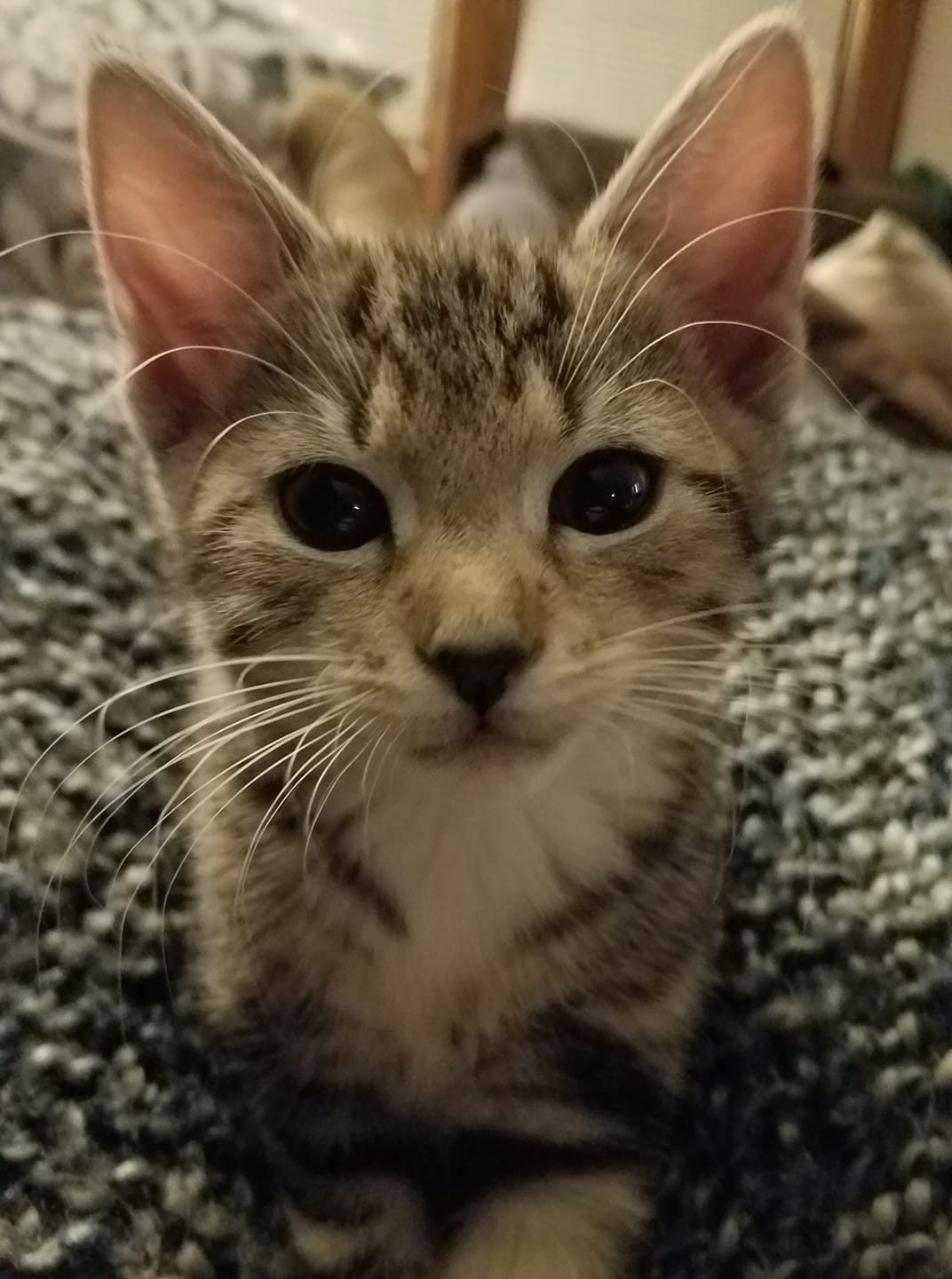
Marcus as a kitten.

While most of my writing work is done solo, the most common helper that I have is a cat. My desk is generally off-limits to my cats, but I occasionally let one in to visit. The most curious of my clowder is Marcus, a 4-year-old who I adopted through work at the beginning of the pandemic. I might have one of the other cats visit, but they are also more nervous to be in the forbidden room.

Marcus last week.

At home, my husband also may weigh in on what I’ve written. I recently asked for his input on a short fiction piece that I’m starting to revise and I’ll show him the finished version once I get it done. We have also toyed with the idea of collaborating on a story, but haven’t seriously worked on this yet.

The other input that is helpful with my writing is to seek out critiques from other writers. I am active in two groups right now. One is exclusively online – Other Worlds Writers’ Workshop (OWWW). The acronym is close to OWW – but that is a different group. Other Worlds is a small but dedicated collection of writers who strive to give honest and helpful critiques of anything in the realm of science fiction and fantasy. We work on both short stories and novels, and the group is run through groups.io. Several members have gone on to be successful in publishing – winning awards and becoming bestselling authors.

The second group where I both submit and critique writing is the Writers of the Weird, part of the Science Fiction Association of Bergen County. This group is local to me and has specific critique sessions. We often meet on Zoom since the pandemic, but some of the sessions are in person. The SFABC offers a lot of activities and information for all fans of science fiction and fantasy, not just writers.

For other writers out there, who helps you write? Are there other groups you think I should check out? Let me know in the comments (above).

Book Review – The Fires of Heaven

The Fires of Heaven is the fifth book in The Wheel of Time series by author Robert Jordan (paid links). I have been slowing working through this series and I’m determined to finish it this time. Read on to see what I thought of this one.

Here are my reviews of the other books in the series:

I read the e-book edition of this.

Here is the blurb:

Prophesized to defeat the Dark One, Rand al’Thor, the Dragon Reborn, has upset the balance of power across the land. Shaido Aiel are on the march, ravaging everything in their path. The White Tower’s Amyrlin has been deposed, turning the Aes Sedai against one another. The forbidden city of Rhuidean is overrun by Shadowspawn.

Despite the chaos swirling around him, Rand continues to learn how to harness his abilities, determined to wield the One Power–and ignoring the counsel of Moiraine Damodred at great cost.


This book picks up with our main characters still scattered around Randland (Note that I’m embracing the term Randland for the world of the Wheel of Time because I’m not sure that Robert Jordan ever gave a name to the world that he created). Siuan and Leane have fled the tower with Min and Logain and the two stilled Aes Sedai work to keep their focus on new goals to put off the despondency that usually follows the loss of the use of the One Power.

Rand has embraced his role as The Dragon Reborn, or the Car’a’carn by the Aiel legends. Yet, the Aiel are split and Rand must lead the Aiel out of the Waste in pursuit of the rebellious Shaido before they cause too much destruction. This theme of political strike and division continues throughout the book. The White Tower is divided, and the realms of Amadicia, Altara, and Andor are plagued by unrest and uncertain leadership. Rand is forced to work with his enemies as he continues to learn how to use his power and fight the Forsaken.

Despite all the events of this book, I felt like the pace has slowed and several scenes could have been easily cut to make this a shorter book. We do see the main characters develop and grow – Rand, Mat, Egwene, and Nynaeve, in particular. Like in the earlier volumes, the end of this book concludes with conflict – both a larger battle and a smaller duel. I’ve already started the next book, Lord of Chaos.

Have you read The Wheel of Time? What do you think of the pacing? Let me know in the comments (above).

Find more of my reviews here.

May 2024 Reading Wrap Up

May was not a great reading month for me. I had a lot of other things going on, as well as some travel. You’d think that I’d have more time to read while traveling, but it doesn’t always work out that way. I lose focus while reading on a plane and then at my destination, I’m often too tired to stay up reading. And while I bring my headphones, I find that I never put on my audiobook in these situations.

The month of May didn’t quite go according to plan. I only finished one book, The Fires of Heaven (Book 5 in The Wheel of Time) by Robert Jordan. I’ll have a review of this one up soon (paid links).

I read two short stories for one of my book clubs. We have pivoted to a short story format for a few months to see if we can get more people attending the discussions. These are the two stories that we recently read, and you can find them for free at these links:

I’m still listening to the audiobook of Voyager (Outlander #3) by Diana Gabaldon, and I should finish this in the next two weeks (14 hours to go). I also started to read Iron Flame by Rebecca Yarros, the second book in the Empyrean series. You can find my review of the first book, Fourth Wing, here. Since I was traveling and had my Kindle with me, I started on the 6th Wheel of Time book immediately after finishing the 5th with Lord of Chaos (paid links).

For June, here are some of the books that I’m planning to read after I finish the ones above.

Let’s see how much I can read as the summer starts!

What are you planning to read next? Let me know in the comments (above).

Musing on the Hugo, Nebula, World Fantasy, and Locus Awards

With the announcement of the finalists for the Locus Awards earlier this month, I thought I’d take some time to muse on why we pick out certain stories for recognition and to also relate some information on the awards that I follow (Hugo, Nebula, World Fantasy, Locus).

I recently read some of the nominees for the Nebula Awards so that I could vote for these (my pick for short story was The Sound of Children Screaming, which can be found here). I’ve also been reading some of the short stories that won Hugos and/or Nebulas in the past couple of years (Rabbit Test, If You Find Yourself Speaking to God, Address God with the Informal You).

So what’s with all these awards? What does each one mean? Who votes for them? And why does anyone care?

First of all, I think that it is important to provide recognition for outstanding talent and achievements in any field. The nomination and awards process also highlights a set of work and helps readers find stories that they might not have been otherwise aware of. Let’s go through each of these major awards and talk about the nomination process, categories, and other information about each one.

Hugo Awards.org media download site, Fair use, https://en.wikipedia.org/w/index.php?curid=60413579

Hugo Awards

The Hugo Awards have been awarded since 1953 and are named for Hugo Gernsback, the founder of the first classic magazine of science fiction, Amazing Stories. The current categories awarded include Best Novel (>40,000 words), Best Novella (17,500 to 40,000 words), Best Novelette (7,500 to 17,500 words), Best Short Story (<7500 words), Best Series, Best Related Work, Best Graphic Story, Best Dramatic Presentation (long and short forms), Best Semiprozine, Best Fanzine, Best Professional Editor, Best Professional Artist, Best Fan Artist, Best Fan Writer, Best Fancast, and Best Game or Interactive Work.

The Hugos are one of the most prestigious awards for the science fiction and fantasy genre. A list of nominees and winners can be found here. The Hugo Awards are presided over by the World Science Fiction Society. Attending and supporting members of the World Science Fiction Convention can nominate and vote on the awards. Even if you can’t attend the convention physically, you can purchase a supporting membership for voting privileges. The physical awards are announced and presented at that year’s World Science Fiction Convention (Worldcon), which is held generally around September and moves to a different city each year (2024 = Glasgow).

The Hugo Awards have been associated with some recent controversies. The Sad Puppies ran a campaign to nominate slates of works in reaction to the recent success of BIPOC authors and overall diversification in the genre. This led to several nominated authors declining to have their works considered (when included on the Sad Puppy slate), and No Award being selected in several categories where the Sad Puppy nominees dominated. The World Science Fiction Society made changes to the nomination and voting process in 2017.

More recently, the 2023 Hugo Awards became the source of another controversy when the voting statistics from the recent Worldcon held in Chengdu, China were released (scroll down to page 20 on the linked .pdf). Authors whose work may have been considered too political for Chinese censorship laws had received nominating votes, but were declared ineligible. Other votes from Chinese citizens were thrown out because they were considered to be following a slate suggested by a magazine (despite the rules not permitting this). Going forward, the Hugo administration has vowed to improve transparency in the process. You can find more details about what happened here.

The logo is from the following website: http://www.sfwa.org/ Nebula Awards official website, Fair use, https://en.wikipedia.org/w/index.php?curid=35826707

Nebula Awards

The Nebula Awards follow a similar process, with the main difference being that those who nominate and vote for these awards must be members of the Science Fiction and Fantasy Writers Association (SFWA). This is the professional organization for authors, artists, and editors in the science fiction and fantasy genres.

Categories for the Nebula Awards currently include Best Novel, Best Novella, Best Novelette, Best Short Story, and Best Game Writing (same word count requirements as for the Hugos). Other awards that are not technically Nebula Awards are also included in the Nebula process. These recently have included the Andre Norton Award for Outstanding Young Adult Science Fiction of Fantasy Book, the Ray Bradbury Award for Outstanding Dramatic Presentation, the Damon Knight Memorial Grand Master Award (for lifetime achievement), Author Emeritus (awarded posthumously for lifetime achievement), the Kevin O’Donnell Award for service to SFWA, and the Kate Wilhelm Solstice Award for significant impact on speculative fiction.

The Nebula Awards go through a similar round of nominations followed by voting, with the announcement and presentation of the winners at the SFWA Nebula Conference. This is usually in the spring and is held in the United States (2024 = Pasadena, California).

World Fantasy Awards

The World Fantasy Awards are a favorite of mine, I think because I lean more toward fantasy in my reading overall. These are administered by the World Fantasy Convention, which occurs annually in a different location around the world (2024 = Niagara Falls, New York). While the World Science Fiction Convention is a larger event with plenty for fans of the genre, the World Fantasy Convention is a professional event for authors, artists, editors, agents, and publishers. It can be a great place to meet people in the field for an upcoming author.

The World Fantasy Award nominees are partly selected by the attendees of the World Fantasy Convention, but also by a panel of judges who are professionals in the field. The categories for awards are Best Novel (>40,000 words), Best Novella (10,000 to 40,000 words), Best Short Fiction (<10,000 words), Best Collection (single author), Best Anthology (multiple authors), Best Artist, Special Award–Professional, Special Award–Non-Professional, Convention Award, and Life Achievement Award.

Controversy about the physical award arose in recent years. It had formerly been a bust of H.P. Lovecraft who has been criticized for his outspoken racism. The new award was changed to the one pictured in 2016.

Locus Awards

Designed by Francesca Myman, with art by Shaun Tan and presented by Locus Magazine. Source: Locus. – Original publication: Locus Magazine Immediate source: https://locusmag.com/2020/06/locus-awards-winners-2020/, Fair use, https://en.wikipedia.org/w/index.php?curid=68857244

The Locus Awards are put together by Locus Magazine, which is a monthly trade publication for the science fiction and fantasy genre. The awards are open for nomination by the public and the votes of subscribers to the magazine count twice. You can find the recent top 10 nominees here.

Categories for the Locus Awards include Best Science Fiction Novel, Best Fantasy Novel, Best Horror Novel, Best Young Adult Novel, Best First Novel, Best Novella, Best Novelette, Best Short Story, Best Anthology, Best Collection, Best Magazine, Best Publisher, Best Editor, Best Artist, Best Non-Fiction, and Best Illustrated and Art Book.

The winners are announced during an awards presentation that is associated with a weekend of readings and panels held in Oakland, California this year.

This has turned out to be a longer post than I thought it would be, but I hope it was helpful to explain some of the honors awarded in the science fiction and fantasy genres.

Have you voted for any of the awards? Which books have you read that won one of these awards? Let me know in the comments (above).

Book Review – On Fragile Waves

I’ve been reading some long books lately. That means that I haven’t finished anything new to review this week, so I’m going to my dwindling backlog for this post.

I read On Fragile Waves by E. Lily Yu last year for one of my book clubs (paid link). It was described as magical realism, which is a sub-genre that I’m not terribly familiar with. I listened to the audiobook, narrated by Jeed Saddy.

I listened to the audiobook edition.

Here is the blurb:

Firuzeh and her brother Nour are children of fire, born in an Afghanistan fractured by war. When their parents, their Atay and Abay, decide to leave, they spin fairy tales of their destination, the mythical land and opportunities of Australia.

As the family journeys from Pakistan to Indonesia to Nauru, heading toward a hope of home, they must rely on fragile and temporary shelters, strangers both mercenary and kind, and friends who vanish as quickly as they’re found.

When they arrive in Australia, what seemed like a stable shore gives way to treacherous currents. Neighbors, classmates, and the government seek their own ends, indifferent to the family’s fate. For Firuzeh, her fantasy worlds provide some relief, but as her family and home splinter, she must surface from these imaginings and find a new way.


The concept of this book sounded interesting enough, and I’m always open to reading diverse perspectives. However, the story told in this book never truly captured my interest and contained very little in the way of fantastical elements. The magical realism aspect comes in when Firuzeh’s friend dies on the journey, but continues to visit Firuzeh and speak to her. I was disappointed overall, and while I finished the book, I don’t even remember how it ended now.

The writing in the book was good and I’d consider reading a different book by the same author. The narrator was easy to listen to and I think that I might not have been able to finish a print or e-book version of this novel. Sometimes I do better finishing an audiobook when I’m struggling to stay engaged with the story.

Have you read any books with a similar setting or theme? Which ones would you recommend? Let me know in the comments (above).

Find more of my reviews here.

Previous Older Entries Next Newer Entries

Follow Blog via Email

Enter your email address to follow this blog and receive notifications of new posts by email.

Join 415 other subscribers