Short or Long, One or Many?

How do you structure your writing time? By this, I mean do you work in several short spurts scattered through the rest of your daily schedule? Or do you have a longer block of time to devote to your craft? Do you write early in the morning or late at night? Do you write every day or only on certain days? I think that much of these are individual quirks but also a subject that I’ve had to revisit recently.

I’ve always had difficulty concentrating on more than one writing project at a time. Whether it’s the initial draft of a novel chapter, a revision pass on a short story, or a blog post like this, it is tough for me to shift gears. I am easily distracted.

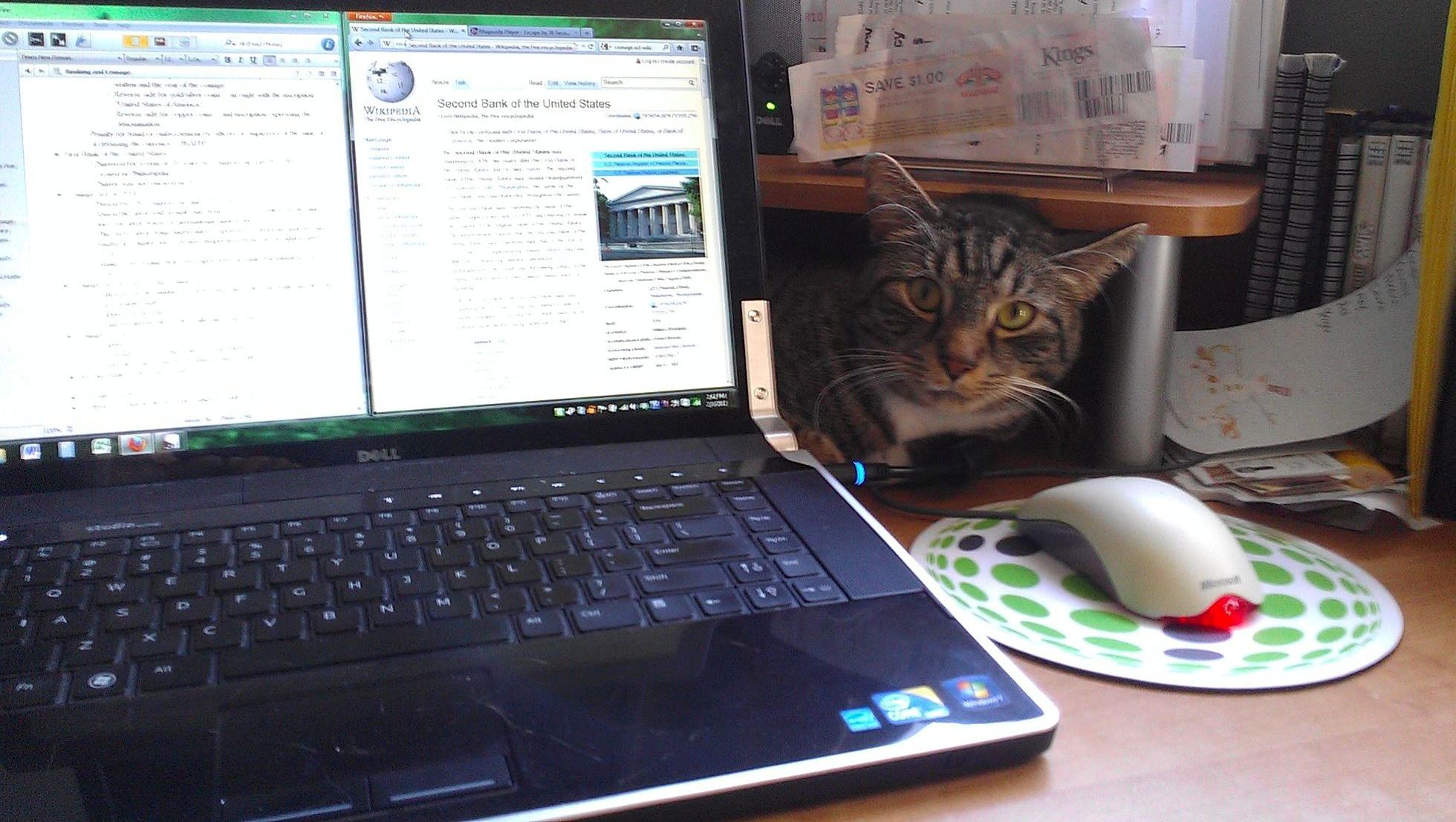
One of my cats tries to help me write.

I think this ties back into the question about how to structure writing time. With full-time work hours, fencing practices and training, personal commitments, and cat wrangling, my writing time is haphazard at best. It is very rare to find more than two hours of uninterrupted time. Often, it is a fraction of that. So when I battle to carve out a block of time and to focus in the first place, trying to shift between plot points and characters is more disorienting than herding those cats. When I try to hop between several tasks all that I end up with are several unfinished projects.

But here I am writing a blog post when I’m in the midst of the first draft of a new short story, as well as the ongoing novel. How is that possible?

Magic? Nope. That would be awesome though.

It comes down to discipline. It’s one thing to think about writing, read books and articles about how to write, or to make to-do lists or goals. In the end, it’s that butt-in-chair effort that is important. Oh, and stop clicking on the nifty internet games, articles, and twitter feeds. I’m getting better about that. Small steps…

The short story draft has a deadline at least. I’ve always been a procrastinator, but when there’s a deadline, I’ll get it done. Although perhaps with only five minutes to spare.

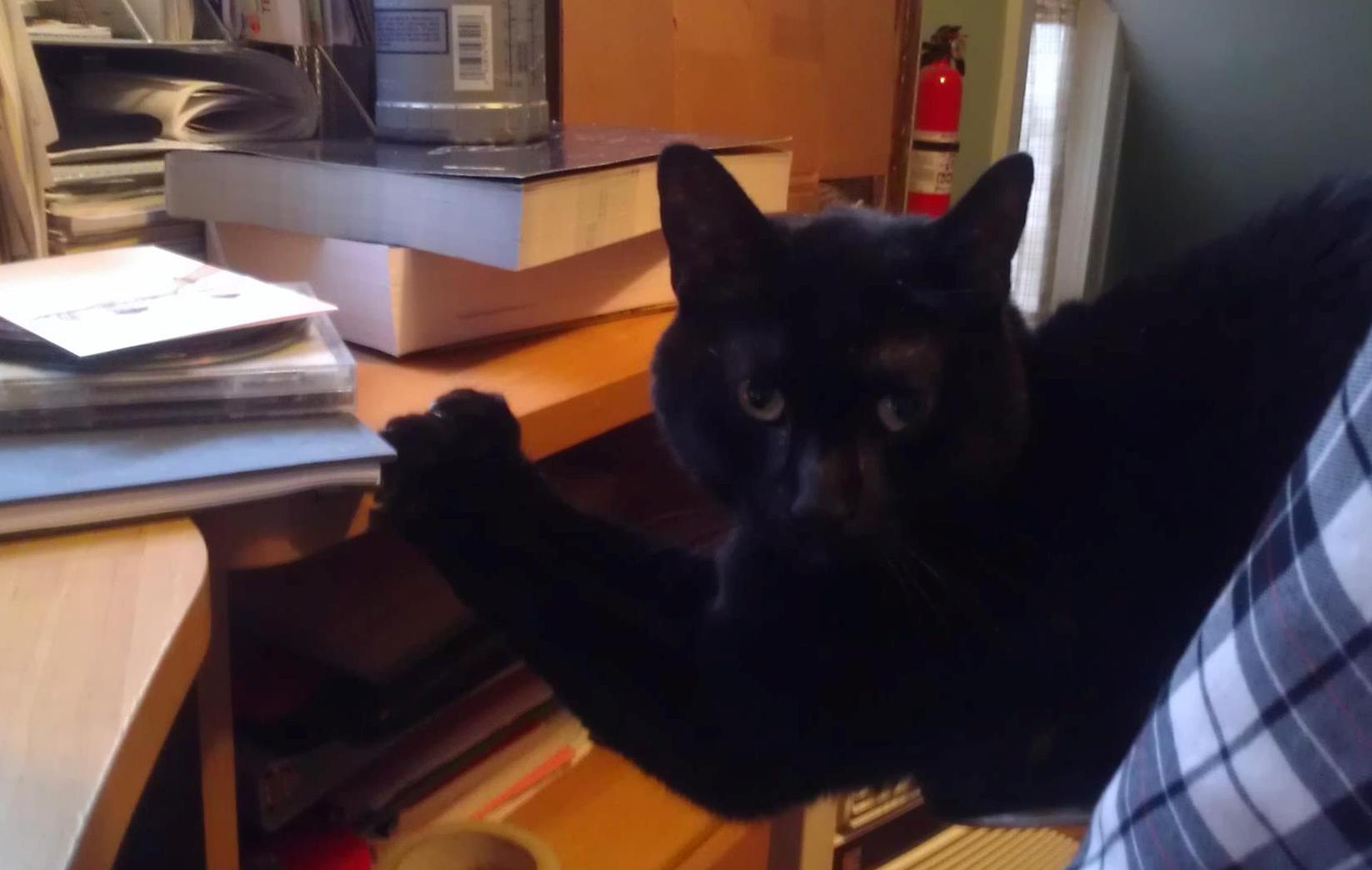
Another cat helps me write.

In other arenas I multitask very well. Perhaps it’s just the written word that unleashes the more scatterbrained parts of my personality. I’m often reading multiple books at the same time. Is this another symptom of the same problem?

So, how do you manage your writing time? Do you set goals by word count or time?

Do you juggle several projects at once? Do you have any tricks or tips to help keep your focus? Do you have to stop to herd cats?

Do You Write What You Know?

This week, I decided to take a break from the posts about fencing. Don’t worry, I’ll get back to that soon – I’m obsessed with swords and there are many fencing topics that I can still write about.

Maybe you’ve heard the oft-muttered writing advice to “WRITE WHAT YOU KNOW” or perhaps you haven’t. But either way, I’ve read several debates on this idea. The gist of it is this: if you fill your writing with settings, subjects, scenarios, or technology that you personally have experienced, then that will give your work greater authenticity. For example, if I’m a  professional chocolate weevil exterminator and I write about a character that is an exterminator, I’ll bring my personal knowledge of that trade to the story. There are details about my life that will infuse the plot and character with some sort of intangible credibility.

The opposite to this would be to “WRITE WHAT YOU DON’T KNOW” which for any author of fantasy or science fiction becomes a necessity at some level. I mean, how many of us have been to another planet? How many of us have worked magic or slain a troll? At some point in our craft, we have to extrapolate and do the best we can with this sort of thing. There is a subset of this that encompasses those subjects or places with which you personally are not familiar, but perhaps thousands or millions of other people are. To me, this is the most difficult type of story to write. This is where the research becomes key. Sure, you can write what you don’t know, but if you do a terrible job of it, someone will pick up on that and that can take them out of of the story. It can ruin their reading experience and cause the story to fail at all other levels.

So writers, do YOU write what you know? It turns out that I usually don’t. Professionally, this is what I know:

Chocolate dog vomit. With wrappers.

That’s vomit.

Dog vomit.

Chocolate dog vomit.

In my day job, I make dogs vomit. I work (nights actually) as an emergency veterinarian. If dogs didn’t eat things that they shouldn’t be eating, I wouldn’t have nearly as much to do. I have to induce vomiting quite often on poor pups that ate a sock, a bottle of medication, or…chocolate.

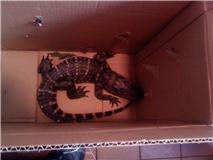
I don’t often write about dogs, cats, or veterinarians, however. This occurred to me as I started to write a story last week that DID involve dogs, cats, and a veterinary office. Of course it also has a zombie and one of these guys in it:

This little alligator was left in a box on the doorstep of the hospital.

I don’t see alligators very often at my job. I went to school in Florida, where I saw them sunning themselves besides drainage ponds while I walked to class. But here in New Jersey?

I have noticed that there seems to be more hard science fiction written about extrapolated physics, astrophysics, and technology than there is advanced biology, genetics, or medicine. Some writers blend the hard sciences and the life sciences in their fiction, but usually one field has a greater influence in the story than the other. Is this a side effect of authors writing what they know?

What do you think? Do you write what you know? Have you tried to write what you don’t know? Have you ever found an alligator in a box on your doorstep?

Oh and hey, I’ll be at ChiCon this weekend (at least the first half of it). If you see me wandering the con, come say hello.

Ouch! Fencing Injuries

When someone mentions fencing and injuries, probably the first thoughts that come to mind involve bloody stab wounds. In sport fencing, actual stab wounds are rare, even though we’re playing with swords. However, there are many other injuries that can happen to a fencer. The goal of today’s post is to discuss the common injuries, aches, and pains that happen almost every day to fencers, as well as some of the more debilitating injuries.

My injured ankle. No, I wasn’t stabbed. It was a bad sprain.

If you’re writing fiction that involves a fencer, it would be good to keep in mind that this person will likely have all types of bumps, bruises, calluses, and other minor afflictions that can annoy them on a regular basis. Fencers have a different level of tolerance for these things. While one fencer might whine about any small bruise, others will show off their scars. What type of character are you writing about?

I think that bruises have to be the most common minor injury in fencing, so much so that I can’t even consider them to be anything unusual. It’s just part of the sport. You’re going to get hit and sometimes it will hurt a little. Sometimes it will sting. Sometimes it will leave a mark. Other times it will make you suck in a deep breath and have to stop to shake it off. Blows on the hand or the elbow can hit a nerve and cause you to drop your weapon. This can make your arm tingle or not respond correctly for a few moments.

The types of bruises vary with the weapon that is being fenced. Since foil and epee are point weapons, most of the bruises will be round. Sabre is a slashing weapon, so most of the bruises will be linear and will fall on the shoulders and arms. Sometimes a sabre attack will have more of a stinging sensation to it. Of all the weapons, I have seen the worst bruises in epee. The epee has a stiffer blade than a foil, so it is less forgiving on impact. I have seen bruises from epee in which not only was there a bruise as large as my hand, but the central part of the bruise was more of a bloody scrape (through the protective equipment). Sometimes novice sabre fencers can get too…enthusiastic. A beginner tends to swing the sabre and to put more of their shoulder strength into the attack. This also makes for more bruises when they land, and will quickly cause the more experienced fencers to show the novice how to lighten up their attacks.

The off-weapon hand has no protection below the wrist. A fencer is supposed to keep that hand back and out of the way, but sometimes it will still get struck. With no glove, it is more likely that the skin will take the brunt of this blow. I’ve often had my knuckles or the back of my hand scraped up, but at least for me, these injuries have never needed more than a few band-aids. On both hands, you can also get your fingernails smashed and bruised.

Oddly enough, the hand seems to be a common place for stab wounds to occur. I know of three fencers that have had a blade go through their hands. I know of another fencer that had a blade go up the sleeve of her jacket and into her arm.

Blisters and calluses are commonplace. As a sabre fencer, I have calluses on my weapon hand – on the thumb and along my palm at the base of my fingers. I’ve had blisters in the same places. Foot blisters and calluses are inevitable for anyone that engages in athletic activities regularly and I’ve had my share of these too. I’ve also slammed my toes against the front of my shoe in an overzealous lunge. A few weeks to a few months later, my toenail fell off.

Fencing is an asymmetric sport. Fencers have one arm that is larger than the other. Fencers will also have a disparity in the size of their legs. Even though both legs are used strenuously, the front leg will tend to be the more heavily muscled one. With all of the quick footwork and lunging that is involved in fencing, it is very common to suffer minor muscle strains in the hamstrings or quadriceps muscles. Some fencers will also get cramps in those muscles or in the calves.

One hazard of sabre fencing is that when an opponent is making at attack with too much of a swinging motion, the blade is flexible and can whip around the weapon’s guard, the shoulder, or the mask. This will sting and can cause more bruises, but one special type of unpleasantness happens when the blade whips around the mask and hits the back of your head. There was a rule change in 2000 that made the sabre blades stiffer, so this is not as common as it used to be.

After being used for some time, the blade of any of the fencing weapons will break. If it breaks near the tip, there is a small piece of metal that is launched out at great speed. I don’t personally know of anyone being injured by this fragment, but I suppose that it is possible. Once the blade breaks, it isn’t sharp, but it is sharper than the unbroken blade. There is a greater chance that this piece could be driven through the opponent’s jacket or mask, but even so, this is rare.

The broken tip from a sabre blade.

A fencer’s mask fits tightly around the chin. If the fencing action becomes too close, sometimes one fencer will inadvertently slam the guard of his weapon into his opponent’s mask. This force can be transferred to the chin and can cause a scrape or bruise there, depending on the exact style and fit of the mask. I don’t know of any fencer that has been knocked out by this.

The non-electric masks (used for foil, epee, or sometimes in practice in sabre) have a painted coating on the mesh surface. When the mask is struck by a blade, sometimes pieces of this paint chip off and can pass through the mask. I have had bits of this go into my eye. It has never been more than an annoyance to me, but I know of one fencer that had to see an ophthalmologist because of a piece that went into his eye.

While I don’t know if there is something officially known as “fencer’s elbow”, the motion used in fencing is repetitive and there is a risk of having various overuse types of injuries like in other sports. I have had tendonitis in my elbow, and I know of other fencers that also have dealt with this.

My foot in a cast. Ow!

As far as serious injuries go, it is much more likely for a fencer to injure a knee or ankle than it is for her to be stabbed. Anything that results from overextension or twisting of a joint could happen. Some of the specific injuries may include a ruptured anterior cruciate ligament, meniscal tears, ankle sprains or fractures, or Achilles’ tendon rupture. I’ve also heard of fencers falling and breaking a wrist or arm. My own ankle sprain involved torn tendons and cracked cartilage, ultimately leading to three surgeries, but was also a bit of an unusual case.

So, are there any fencers out there that have had your own experiences with injury? How did you deal with it?

For the writers, do you need to give your character a weakness – why not an old fencing injury? Or if you’d like to add more realism to a fencing scene, you could use some of the details above.
Building a Plot

There are several different ways that an author can build a novel out of a loose collection of ideas, characters, and plot elements. After reading about the experiences of other writers, this seems to break down into two basic categories: Outliners and Pantsers.

An Outliner has to figure out the scenes or chapters that the story will follow in some minimum level of detail. The ending is known before the writing has begun. A Pantser takes the opposite approach, settling only a few aspects of the novel-in-her-head before sitting down to write by-the-seat-of-her-pants. The ending may be a complete mystery to the author, or while the conclusion may already have been visualized, the author does not know the path that the characters will take to get there.

In my own story-telling projects, I’ve always thought that I identified better as an Outliner. I need to know how it all fits together before I can begin. Who are my characters and why are they going to act the way they do? What difficulties will they face that will force them to grow or change? While there certainly may be times that a Pantser technique could work for me, given what I’ve discovered through several unfinished writing projects is that it more often will not.

As I sat down in mid-February to begin putting the details down for my current novel project, I’ve found that the process of outline creation is no easy feat. I have a character and a disturbing event. I have a setting with the different cultures, sub-cultures, and factions. The magic is roughed out and the monsters are coming to life in my head. Two main antagonists are ready to release their minions. Yet, that outline is a vague list of events and possibilities, haziest in the middle.

How does an author figure out that middle (muddle)? I’m not sure yet, but I’ve decided that I’m an alternating Outliner-Pantser-Outliner. Here’s how I hope it will go:

1) Outline until I can’t stand it anymore.

2) Write until I run out of outline.

3) Stand back and look at what I’ve done (eeek!).

4) Outline the next section.

5) Repeat from step #2.

I suspect that it will turn out messier than this. So, for other authors out there, how do you plan your plot and scenes? Leave some comments – it’s fun!

*   *   *   *   *

I would like to thank the Woodbridge Science Fiction and Fantasy Meetup group for pointing me toward WordPress and spurring me to create this web site.

Next Newer Entries

Follow Blog via Email

Enter your email address to follow this blog and receive notifications of new posts by email.

Join 415 other subscribers