

While I have a back log of reviews to get to, it’s always easiest to write a review when the book is fresh in my mind. Alien Clay by Adrian Tchaikovsky is a stand-alone science fiction novel that I recently finished in August for a book club discussion (paid link). You can find out what I thought below.
Alien Clay was nominated for the 2025 Hugo Award for Best Novel and the 2025 Locus Award for Best Science Fiction Novel. It also won a Special Citation in 2025 from the Philip K. Dick Award. I wasn’t aware of this award but it is given by the Philadelphia Science Fiction Society together with the Philip K. Dick Trust for the best original paperback published in the U.S. that year. Looking through the list of winners, citations, and nominees, I found that I wasn’t familiar with most of the books on it. Next time I’m looking for new science fiction to read, this list might be a great resource.
I have previously read and reviewed one other book by this author:
In writing this post, I also just discovered that the author has a sequel to Elder Race coming out on September 1, 2026, called Engines of Reason. You can pre-order it here.
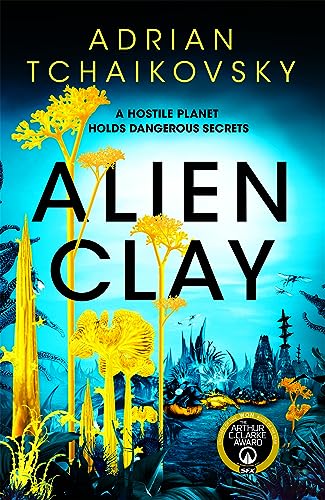
Here is the blurb:
The planet of Kiln is where the tyrannical Mandate keeps its prison colony, and for inmates, the journey there is always a one-way trip. One such prisoner is Professor Arton Daghdev, xeno-ecologist and political dissident. Soon after arrival, he discovers that Kiln has a secret. Humanity is not the first intelligent life to set foot there.
In the midst of a ravenous, chaotic ecosystem are the ruins of a civilization, but who were the vanished builders and where did they go? If he can survive both the harsh rule of the camp commandant and the alien horrors of the world around him, then Arton has a chance at making a discovery that might just transform not only Kiln, but distant Earth as well.
I had some trouble starting this book, but that was mostly due to a busy schedule and lack of sleep on my part, rather than due to any problem with the book. The first pages include a Dramatis Personae, but I found that I never needed to flip back to reference this. Once I had more free time to dedicate to reading, this was a stellar book that I (mostly) read in two days.
The opening shows both the protagonist, Arton Daghdev, and the ruthless attitude of the Mandate as Arton arrives on the planet of Kiln. The idea of “acceptable wastage” is introduced, basically acknowledging that some prisoners will die quickly and as long as the numbers aren’t too high, no one back on Earth will care. The prisoners are essentially freeze dried for one-way transport to their alien prison, while the leadership and staff get to ride in a safer ship that allows a return voyage when their period of work is done.
The novel interweaves two main themes: rebellion against an oppressive regime and weird and poorly understood planetary biology. The Mandate wants to force the science to fit their philosophy, so while the main antagonist, Commandant Terolan, is tasked with enforcing order on Kiln, he also needs those prisoners with an academic background in relevant fields to help the stalled research of his regular staff. Arton receives special attention from Terolan and waffles between wanting to study the alien structures and the ecology of Kiln, while also continuing to rebel against the government that sent him here.
His fellow prisoners are not welcoming initially and a minor theme throughout the book is trust. Arton already knows several of the inmates and while he knows that he never snitched on anyone, he both realizes that someone had snitched on him on Earth and fears that the others believe he did the same to them. Arton’s character is believable in how he waffles between his own fear of further punishment and his deep-seated need to continue to fight against the oppression and poor science of the Mandate.
One of the best parts of Alien Clay is the biology of the life on Kiln. Arton is not given full privileges to engage in research because he is still a prisoner, but gradually gleans information from his captors as he is allowed to work for the official scientists. Arton’s past as a well-respected researcher in academia also flavors the story, and I imagine readers who work in academia will appreciate this more than others. No one who is a leader in their field has chosen to come to Kiln to work, but those less successful academics who did join the colony oversee prisoners with more publications and expertise, leading to snarky lines like this one from Arton:
“We know it all. Lay down your guns and I’ll let you and Terolan peer-review my paper on it.”
As an aside, the life on Kiln reminded me in many ways of the 2023 HBO animated series, Scavenger’s Reign. While this show was unfortunately not renewed for a second season, the first season was incredible and still worth watching for anyone who likes science fiction involving a lot of biology.

I don’t want to spoil anything about the mysteries of Kiln or the ending of this book, so I will only say that the author brings all of these ideas together to a satisfying conclusion that left me thinking for days afterward.
Have you read other science fiction books that lean heavily on biology rather than physics or engineering? Which ones would you recommend? Let me know in the comments.
You can find more of my book reviews here.