

This week, I decided to take a break from the posts about fencing. Don’t worry, I’ll get back to that soon – I’m obsessed with swords and there are many fencing topics that I can still write about.
Maybe you’ve heard the oft-muttered writing advice to “WRITE WHAT YOU KNOW” or perhaps you haven’t. But either way, I’ve read several debates on this idea. The gist of it is this: if you fill your writing with settings, subjects, scenarios, or technology that you personally have experienced, then that will give your work greater authenticity. For example, if I’m a professional chocolate weevil exterminator and I write about a character that is an exterminator, I’ll bring my personal knowledge of that trade to the story. There are details about my life that will infuse the plot and character with some sort of intangible credibility.
The opposite to this would be to “WRITE WHAT YOU DON’T KNOW” which for any author of fantasy or science fiction becomes a necessity at some level. I mean, how many of us have been to another planet? How many of us have worked magic or slain a troll? At some point in our craft, we have to extrapolate and do the best we can with this sort of thing. There is a subset of this that encompasses those subjects or places with which you personally are not familiar, but perhaps thousands or millions of other people are. To me, this is the most difficult type of story to write. This is where the research becomes key. Sure, you can write what you don’t know, but if you do a terrible job of it, someone will pick up on that and that can take them out of of the story. It can ruin their reading experience and cause the story to fail at all other levels.
So writers, do YOU write what you know? It turns out that I usually don’t. Professionally, this is what I know:

Chocolate dog vomit. With wrappers.
That’s vomit.
Dog vomit.
Chocolate dog vomit.
In my day job, I make dogs vomit. I work (nights actually) as an emergency veterinarian. If dogs didn’t eat things that they shouldn’t be eating, I wouldn’t have nearly as much to do. I have to induce vomiting quite often on poor pups that ate a sock, a bottle of medication, or…chocolate.
I don’t often write about dogs, cats, or veterinarians, however. This occurred to me as I started to write a story last week that DID involve dogs, cats, and a veterinary office. Of course it also has a zombie and one of these guys in it:
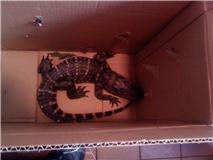
This little alligator was left in a box on the doorstep of the hospital.
I don’t see alligators very often at my job. I went to school in Florida, where I saw them sunning themselves besides drainage ponds while I walked to class. But here in New Jersey?
I have noticed that there seems to be more hard science fiction written about extrapolated physics, astrophysics, and technology than there is advanced biology, genetics, or medicine. Some writers blend the hard sciences and the life sciences in their fiction, but usually one field has a greater influence in the story than the other. Is this a side effect of authors writing what they know?
What do you think? Do you write what you know? Have you tried to write what you don’t know? Have you ever found an alligator in a box on your doorstep?
Oh and hey, I’ll be at ChiCon this weekend (at least the first half of it). If you see me wandering the con, come say hello.